

Establishing a power of attorney for an elderly parent is one of the most important legal steps you can take. It’s a document that gives a trusted person the power to make critical decisions if your parent can no longer make them on their own. When a parent’s health starts to decline, having this in place ahead of time prevents a family crisis by making sure someone can manage their finances and healthcare without getting the courts involved.
Why a Power of Attorney Is Essential for Elder Care
Watching a parent get older brings a mix of love, worry, and a lot of tough questions. One day they're perfectly fine, and the next you're starting to wonder if they can handle their daily life.
What if your mom has a sudden stroke and can't pay her bills or tell doctors what she wants? Without a Power of Attorney (POA), your family could be in a legal bind, locked out of her bank account and unable to speak with her medical team about a care plan.

A Power of Attorney isn’t about taking control away from your parent. Think of it as a proactive act of love that respects their wishes and protects their future. It's a fundamental piece of responsible elder care planning, especially when you start thinking about a move to an assisted living community. The POA empowers the person they choose—the agent—to step in seamlessly, ensuring there’s no disruption in care or financial stability during a difficult time.
The Growing Need for Proactive Planning
As our population ages, the Power of Attorney has become an absolutely vital legal tool. Here in the United States, the number of adults over 65 is expected to hit about 73 million by 2030. That means families are facing more years where they need to plan for potential incapacity.
Unfortunately, too many families put this off. Studies have found the average age for setting up a POA is 78, which often means it's done after health issues have already started. This delay can create a stressful, expensive court process called a guardianship, where a judge—not your parent—gets to decide who takes over.
A Power of Attorney is the difference between your parent choosing their trusted advocate and a court appointing one for them. It’s a simple document that prevents complex problems.
What a POA Allows You to Do
To really get why a Power of Attorney is so critical, you have to understand What is a Power of Attorney?. This document gives your chosen agent the legal authority to handle specific duties, which could include:
- Financial Management: Paying bills, managing investments, filing taxes, and even applying for benefits like Medicaid to help cover long-term care costs.
- Healthcare Decisions: Talking with doctors, approving medical treatments, and making care choices that align with what your parent would have wanted.
- Logistical Support: Dealing with insurance claims, managing property, and making arrangements for in-home help or a transition into an assisted living facility.
Without this legal authority, banks, hospitals, and other institutions simply won't talk to you, citing privacy laws. This can be completely paralyzing when your parent is struggling with their activities of daily living and you're trying to get them the help they need. A POA breaks down those barriers so you can act quickly and effectively for them.
Understanding the Key Types of POAs in Texas
When you start looking into a power of attorney for an elderly parent, you'll find it's not a single document. In Texas, the law wisely separates decision-making power into different buckets. For most families, this means setting up two distinct POAs to create a complete safety net for your mom or dad.
Think of it as having one specialist for your parent's physical health and another for their financial well-being. Trying to get by with only one of these documents is like trying to row a boat with a single oar—you'll just spin in circles when a crisis hits.

Getting a handle on what each POA does is the essential first step. It makes sure the person you choose—called an "agent"—has the right legal authority to act, whether that's talking to a doctor about a care plan or paying the monthly invoice for an assisted living community.
The Medical Power of Attorney for Healthcare Decisions
A Medical Power of Attorney (MPOA), sometimes called a healthcare proxy, deals exclusively with health-related choices. This document gives your agent the power to make medical decisions only after a doctor certifies that your parent can no longer make those decisions for themselves.
This piece of paper is your key to navigating the healthcare maze. A properly appointed agent can:
- Talk to the Medical Team: They can legally get medical records, understand a new diagnosis, and ask the tough questions.
- Consent to or Refuse Treatment: This includes everything from agreeing to surgery to deciding on a course of medication.
- Guide End-of-Life Care: The agent can ensure your parent's wishes about life support or comfort care are honored, especially when paired with a living will.
Here’s a real-world example: Your mom is hospitalized and, due to her dementia, is too confused to understand her treatment options. The MPOA allows her agent to step in immediately, authorize the right tests, and consent to care that aligns with her known values, all without frustrating legal delays.
The Durable Power of Attorney for Financial Matters
While the MPOA covers health, the Durable Power of Attorney is all about the money and property. It’s an incredibly powerful and flexible tool that lets your agent manage your parent's entire financial life. And that word, "durable," is critically important.
In Texas, a "durable" power of attorney stays in effect even if your parent becomes incapacitated. A non-durable POA, on the other hand, becomes useless at the exact moment you need it most, making it completely wrong for elder care planning.
The financial authority granted is broad. An agent with a durable POA can step in to handle a huge range of tasks:
- Pay all the bills, from the mortgage to the assisted living community fees.
- Manage bank accounts, IRAs, and other investments.
- File your parent’s tax returns.
- Sell property, like the family home, to generate funds for long-term care.
- Apply for benefits like Social Security or VA Aid and Attendance.
Imagine your father needs to move into assisted living, but he's no longer capable of handling the sale of his house to pay for it. With a Durable Power of Attorney, his agent can manage the entire transaction—from listing the home to signing closing papers—to make sure the money is there for his care. Without it, the family would be stuck, facing a long and costly court battle for guardianship.
Medical vs Financial Power of Attorney At a Glance
To make it even clearer, here's a simple breakdown of the two essential documents.
| Feature | Medical Power of Attorney (MPOA) | Durable Power of Attorney (Financial) |
|---|---|---|
| Primary Purpose | Make healthcare and medical treatment decisions. | Manage finances, property, and legal affairs. |
| When It Activates | Only when a doctor certifies the parent cannot make their own decisions. | Typically effective immediately upon signing unless otherwise specified. |
| Agent's Authority | Access medical records, consent to surgery, make end-of-life choices. | Pay bills, manage bank accounts, sell real estate, file taxes. |
| Key Term | Also known as a "healthcare proxy." | "Durable" means it remains valid even if the parent is incapacitated. |
| Common Scenario | Authorizing a medical procedure for a parent with advanced dementia. | Selling a parent's home to fund their transition to assisted living. |
For true peace of mind and comprehensive protection, almost every family needs both of these documents securely in place. They work together to ensure every aspect of your parent's life is looked after.
How to Choose the Right Agent for Your Parent
Picking the person who will act on your parent's behalf—the agent—is easily the most important decision you'll make when setting up a power of attorney for an elderly parent. This is not a role that automatically goes to the oldest child. It’s a serious job that requires a unique blend of trust, diligence, and a steady hand.
Your parent is literally placing their future well-being in this person's hands. The right agent will honor their wishes with integrity, no questions asked. The wrong one can, even with the best intentions, create family drama and serious financial headaches. This decision needs a real, thoughtful conversation, not a quick assumption.
Core Qualities of a Dependable Agent
Before anyone even starts throwing names around, it’s a good idea to map out what makes an ideal agent. This little trick shifts the focus from family politics to practical qualifications, which can save a lot of hurt feelings among siblings. A reliable agent is someone who is fundamentally trustworthy, of course, but it goes much deeper than that.
Think about these key traits:
- Highly Organized: This person will be juggling complex paperwork, tracking deadlines, and keeping meticulous records of every dollar spent and every decision made. If someone can't find their car keys most mornings, they probably aren't the best fit to manage your parent's life savings.
- Assertive and Resolute: Your parent needs a strong advocate. The agent might have to challenge a doctor's opinion, negotiate with a bank, or even stand up to another family member who disagrees with a care decision. A pushover won't cut it.
- Emotionally Level-Headed: Making decisions during a health crisis is incredibly stressful. The best agent can stay calm under pressure and think rationally, even when emotions are running high for everyone else.
- Geographically Available: While not an absolute deal-breaker, living nearby is a huge plus. An agent who is a plane ride away will have a tough time responding to emergencies, meeting with doctors, or handling day-to-day issues that pop up.
Choosing an agent isn't about being fair or following birth order; it's about appointing the most qualified person for a very demanding job. This person becomes your parent's voice and protector when they can no longer fill those roles themselves.
Navigating Family Dynamics and Potential Conflicts
Let's be honest: talking about who should be the agent can be a minefield, especially when there are multiple siblings. One child might feel they are entitled to the role, while another might feel completely overwhelmed by the thought of it. The key is to have an open, frank conversation, preferably led by your parent.
Imagine a family with two siblings. One lives in the same town and is a whiz with spreadsheets, while the other lives across the country and has a strained relationship with the parent. The choice might seem obvious, but just naming the local sibling without a discussion could breed resentment that lasts for years.
A better way to handle this is to frame the decision around the job's practical demands. Instead of saying, "Mom wants you," try something like, "Mom needs someone who can get to the bank on a Tuesday afternoon and keep all her medical bills straight." When you focus on the tasks, the decision feels less personal and more logical.
It’s also absolutely critical to name at least one alternate agent. What if the primary agent gets sick, moves away, or simply can't handle the stress anymore? Without a designated backup, the whole plan can collapse, potentially forcing the family into a court-ordered guardianship. An alternate ensures there’s always a trusted person ready to step in.
The Agent's Role in Long-Term Care Decisions
The agent's duties often kick into high gear when it's time to start planning for long-term care. This person will be the one executing the logistics of a huge life transition, like a move into assisted living. They'll be using the financial POA to manage the sale of a home and pay the facility's monthly fees, and the medical POA to coordinate care with the nursing staff.
This really shines a light on why it's so important to pick someone who not only gets your parent's finances but also deeply understands their values. When the time comes, knowing how to choose assisted living is about more than just numbers on a page; it's about finding a place where your parent will feel safe, respected, and truly at home. The agent has to be capable of making that compassionate, well-informed choice on their behalf.
The Texas Legal Process for Creating a POA
Once you’ve found the right person to be the agent, the next hurdle is making the power of attorney for an elderly parent legally binding here in Texas. This isn't just about getting a signature on paper. The state has very specific rules that you have to follow to the letter.
Getting this part wrong can unravel everything. An invalid document is useless, leaving your family scrambling and unprotected precisely when you need that protection the most.
While the legal side of things can feel intimidating, it’s a pretty straightforward path if you know the key milestones. The whole process is designed to protect your parent, making sure the document is a true reflection of their wishes and signed without any confusion or pressure. Let’s walk through what’s involved, from finding the right forms to avoiding the common mistakes I see families make all the time.
Finding the Correct Texas Statutory Forms
First things first: you absolutely have to use forms that comply with Texas law. I can't stress this enough. You can find a million generic POA templates online, but using one that isn't built for Texas is a massive risk. Banks, hospitals, and other institutions are trained to spot and reject non-compliant documents, which could cause a devastating delay during an emergency.
The Texas Legislature has made this easier by creating official statutory forms for both the Medical Power of Attorney and the Durable Power of Attorney. These forms contain the exact language that is legally recognized across the state. Using them is by far the safest and most reliable way to go.
- Durable Power of Attorney: This form lives in the Texas Estates Code, Chapter 752. It’s designed to let your parent grant or withhold specific financial powers, giving them total control over the agent's authority.
- Medical Power of Attorney: You'll find this one in the Texas Health and Safety Code, Chapter 166. It clearly states the agent’s authority only kicks in when a doctor certifies that your parent can no longer make their own healthcare decisions.
You can usually get these forms from an elder law attorney, reputable legal websites, or by looking up the Texas statutes directly. Just promise me you won’t grab the first generic form you find on Google.
Ensuring Your Parent Has Legal Capacity
This is a critical point. For any Power of Attorney to be valid, your parent has to sign it while they are of "sound mind." In legal terms, this is called having capacity. It means they need to understand a few basic things:
- What a POA Is: They have to grasp that they are giving another person the legal power to make decisions for them.
- Who the Agent Is: They must be clear on who they are appointing and what that person will be responsible for.
- The Nature of Their Assets: For a financial POA, they need a general understanding of their property and money.
A POA signed by a parent who already has advanced dementia and doesn’t understand the document can be challenged and thrown out by a court. If there's any question about your parent’s cognitive state, it's a good idea to have a doctor assess their capacity and put it in writing at the time of the signing.
Meeting Texas Witness and Notary Requirements
Texas has strict rules for how these documents are signed, all to prevent fraud and prove the document is authentic. This is where many families trip up.
A Durable (Financial) Power of Attorney has to be signed by your parent in front of a notary public. The notary’s job is to verify their identity, watch them sign, and then add their official seal. Witnesses aren't required for this one, but the notarization is mandatory.
The following infographic illustrates the key qualities to look for when choosing an agent for this crucial role.
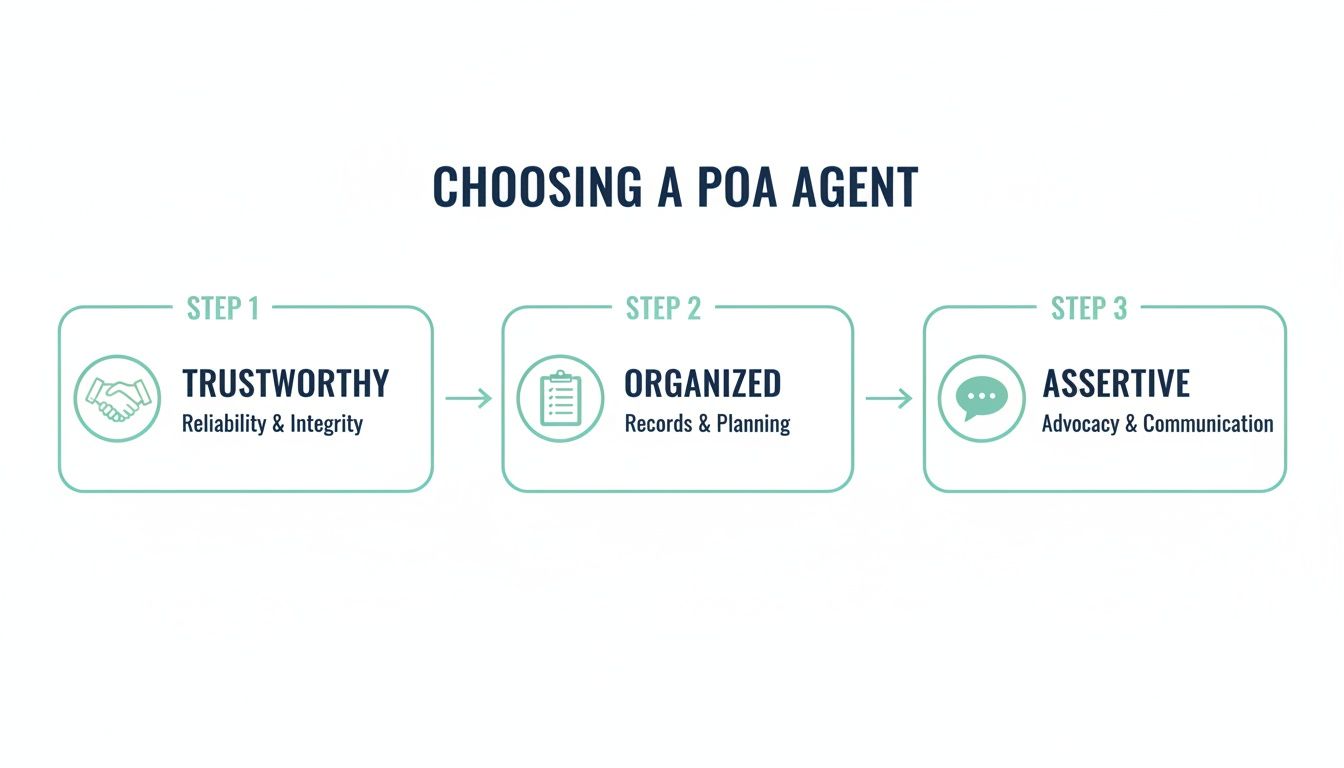
This visual process emphasizes that the agent must be trustworthy, organized, and assertive to effectively manage your parent's affairs.
A Medical Power of Attorney has a different set of rules. It must be signed in the presence of two competent adult witnesses. The other option is to sign it before a notary.
Crucial Witness Rule: The witnesses for a Medical POA cannot be the agent, a relative (by blood or marriage), anyone named in your parent's will, their doctor, or an employee of their healthcare facility. Using the wrong person as a witness is a common mistake that will void the document.
The Importance of a HIPAA Release Form
One last thing that’s often overlooked: a Power of Attorney alone doesn't guarantee access to medical records. A federal law called the Health Insurance Portability and Accountability Act (HIPAA) puts strict protections on personal health information.
To make sure your agent can actually talk to doctors, your parent needs to sign a separate HIPAA release form. This document gives healthcare providers explicit permission to share your parent’s medical information with the agent you've named.
Without it, doctors might refuse to discuss your parent’s condition, even if you’re holding a valid MPOA. This form is a vital part of comprehensive end-of-life planning and is essential for allowing your agent to do their job.
Using a POA to Prevent Elder Financial Abuse
Beyond just paying the day-to-day bills, a properly set up power of attorney for an elderly parent is one of the strongest shields you can have against the heartbreaking crisis of elder financial abuse. This isn't just some far-off problem you see on the news; it's a real and immediate danger that can erase a lifetime of savings with shocking speed.
A Durable Power of Attorney gives your chosen agent the legal authority to become an active guardian of your parent’s finances. With this document in hand, they can be more than just a helper—they become a protector.

This means your agent can step in to monitor accounts for odd activity, dispute strange charges with credit card companies, and serve as the official point of contact for financial institutions. Banks are often the first to spot red flags, but their hands are legally tied—they can't discuss their concerns with family members who don't have this formal authority.
The Alarming Reality of Elder Fraud
The numbers behind elder financial exploitation are staggering and really drive home the urgent need for protective tools like a POA. The National Council on Aging estimates that seniors lose a devastating $36.5 billion every single year to financial scams and abuse. In 2023 alone, the FBI reported that elder fraud losses soared past $3.4 billion.
What's even more troubling is that these figures are likely just the tip of the iceberg. A 2023 study linked to AARP found that a shocking 87.5% of elder financial abuse cases go unreported, often because of shame or fear. Without a well-drafted financial power of attorney, family members have no immediate legal standing to stop harmful transactions without going through long and expensive guardianship proceedings.
A Durable Power of Attorney transforms you from a worried bystander into an empowered first responder. It's the legal key that unlocks your ability to intervene before a financial scam turns into a catastrophe.
To really put a POA to work preventing elder financial abuse, it's vital to understand the problem itself. You can learn more about What Is Elder Financial Abuse and How to Stop It.
How an Agent Provides a Financial Shield
Think about a classic, all-too-common scenario: a scammer on the phone convinces your dad that he owes back taxes and has to pay immediately with gift cards. Without a POA, you might only find out after his accounts have been drained.
With a Durable Power of Attorney, however, the agent can take proactive and decisive action:
- Set Up Account Alerts: The agent can ask the bank to send them a notification for any large or unusual withdrawals.
- Communicate with Financial Institutions: They can place a hold on an account if they suspect fraud and work directly with the fraud department to resolve it.
- Block Scammers: The agent can step in to change phone numbers, block suspicious contacts, and manage online account security settings.
- Preserve Funds for Care: Most importantly, this protective oversight ensures your parent's money is kept safe for its intended purpose, like paying for their long-term care.
This level of hands-on management is crucial, especially when you're starting to explore care options. Figuring out the costs of assisted living is a huge piece of the financial planning puzzle. Our guide explaining if Medicaid pays for assisted living can give you some much-needed context. Protecting your parent's assets today ensures they have the resources they need for a safe and comfortable future.
Common Questions About Texas Power of Attorney
Even with a solid plan, the process of setting up a power of attorney for an elderly parent always seems to bring up more questions. It's easy to get tangled in the legal details, but getting clear answers is the best way to feel confident moving forward. Let's walk through some of the most common questions Texas families ask.
When Does a Power of Attorney Take Effect?
This is a big one, and it all comes down to how the document is written. In Texas, a Durable Power of Attorney for finances usually becomes effective the moment it's signed and notarized. Many families actually prefer this, as it allows the agent to step in and help with bills or other financial tasks right away, even while the parent is still perfectly capable.
The other route is a "springing" power of attorney. This document only "springs" into effect after a specific event occurs, most often when a doctor certifies in writing that your parent is incapacitated. While that might sound safer, it can create frustrating and even dangerous delays during a crisis. Proving incapacity isn't instant, and you might not have that kind of time. That's why an immediately effective durable POA is often the more practical choice for elder care.
A key takeaway: An immediately effective Durable Power of Attorney allows for a smooth transition if help is needed, whereas a "springing" POA can create serious logistical hurdles right when you need to act fast.
Can My Parent Revoke a Power of Attorney?
Absolutely. As long as your parent is mentally competent and fully understands what they're doing, they have every right to revoke a Power of Attorney at any time. Texas law is built to protect their autonomy.
But to be legally effective, the revocation has to be done by the book.
- Put It in Writing: Your parent needs to sign and date a formal document clearly stating they are revoking the POA.
- Get It Notarized: Just like the original POA, the revocation document should be notarized to confirm its authenticity.
- Notify Everyone: This is the most critical step. You must deliver copies of the signed revocation to the person who was the agent and to every single institution that has a copy of the original POA—think banks, brokerage firms, doctors' offices, and hospitals.
If an institution isn't formally notified, they can legally continue to honor the old POA. It's also important to know that if your parent is no longer mentally competent, they cannot revoke the document. This really highlights why choosing someone you trust without reservation from the very beginning is so essential.
What if There Is No POA and My Parent Is Incapacitated?
This is the exact crisis a Power of Attorney is designed to head off. If your parent becomes incapacitated and there's no POA, you have zero automatic legal authority to manage their affairs. Banks won't talk to you about their accounts, and doctors might be limited in what they can share.
At that point, your only option is to go to court and petition for a guardianship. It's a path that is often:
- Public: Your family's private financial and medical details become part of the public court record.
- Expensive: Guardianship proceedings come with significant attorney's fees and court costs.
- Time-Consuming: It can take months just to get a hearing and have a judge appoint a guardian.
Under a guardianship, a judge—not your parent—decides who will be in charge. That person is then supervised by the court, required to file annual reports, and must ask for permission for major decisions. A POA is a much simpler, more private, and less costly way to make sure your parent's chosen person can act for them when it counts. You can find more details on related topics in our extensive list of frequently asked questions about senior care.
Does a POA Need to Be Filed With a Texas Court?
For the most part, no. A Power of Attorney is a private legal document. It doesn't need to be filed with a Texas court to be considered valid and enforceable. For day-to-day transactions, like managing a bank account or discussing medical care, presenting a valid, notarized copy to the institution is all that’s needed.
The big exception to this rule involves real estate. If your agent needs to handle a property transaction for your parent—like selling their home to help pay for a move to assisted living—the Durable Power of Attorney must be recorded. It has to be filed in the official real property records of the county where the property is located. This recording makes the agent’s authority a matter of public record, which is what title companies need to see to legally recognize and complete the sale.
At Forest Cottage Senior Care, we understand that navigating these decisions is just one part of the journey. If you have more questions about planning for long-term care, we invite you to schedule a visit and see how our compassionate community can support your family. Learn more at http://44.202.110.106.