

The real difference between assisted living and home care boils down to two things: where the care happens and how deep it goes. Think of it this way: assisted living is a complete community experience with round-the-clock support, social life, and services all under one roof. On the other hand, home care brings personalized, one-on-one help right into a senior's own home.
So, the choice really hinges on what you’re prioritizing. Is it a structured, social environment with constant backup, or is it about holding onto the independence of living at home?
Choosing the Right Senior Care Path in Willis TX
Figuring out whether assisted living or home care is the right call is a huge decision for any family. It’s about more than just logistics; it’s about making sure the person you love is safe, happy, and truly living well. This guide is designed to cut through all the noise and give you a clear, straightforward comparison of these two popular options, focusing on the factors that actually matter.

Key Differences at a Glance
First things first, let's get a clear picture of what we're talking about. Assisted living is a residential community built for seniors who need a hand with daily activities (often called Activities of Daily Living, or ADLs) but are still independent in many ways. Home care is different; it involves bringing a skilled caregiver or health aide directly into a senior’s home for a certain number of hours each day or week.
For families here in the Willis, TX area, getting this distinction right is the critical first step. You can see assisted living as a proactive, all-in-one solution, while home care acts as a targeted support system that fits into an existing home life. If you're leaning toward a community setting, our guide on how to choose assisted living has some great questions to help you think through the decision.
To make it even clearer, here’s a quick breakdown of the main differences.
Quick Comparison Assisted Living vs Home Care
This table gives a high-level look at how these two options stack up against each other, helping you see the fundamental differences in a single glance.
| Feature | Assisted Living Community | In-Home Care |
|---|---|---|
| Environment | Community-based, residential setting with private or shared rooms. | Senior's private home or a family member's residence. |
| Social Life | Built-in social activities, communal dining, and daily peer interaction. | Limited to caregiver visits, family, and existing social circles. |
| Staffing | 24/7 on-site staff, including care partners and often nursing personnel. | Caregivers are present only during scheduled, paid hours. |
| Cost Structure | Typically an all-inclusive monthly fee covering housing, meals, and care. | Billed at an hourly rate, with costs scaling based on hours needed. |
| Services | Bundled services including meals, housekeeping, transportation, and activities. | Services are provided à la carte, focusing on specific care tasks. |
Ultimately, one isn't inherently "better" than the other. The best choice is the one that best fits your loved one's specific needs, personality, and financial situation.
Understanding Each Senior Care Model
When you’re weighing assisted living against home care, it's easy to get stuck on the basic definitions. But the truth is, each option represents a completely different philosophy on support, daily life, and the environment your loved one will experience. Getting to the heart of these differences is the first real step in making a choice your family can feel good about.
Assisted living isn't just a place to live; it's a community designed from the ground up to blend independence with professional support. Residents have their own space, whether it's a private or shared room, but they're part of a larger ecosystem of care that's available 24/7. The whole model is built to take the burdens of daily life off their shoulders so they can focus on staying healthy and engaged.
This shift toward structured, community-based care is becoming more and more common. The global assisted living market was recently valued at USD 157.28 billion and is expected to hit USD 271.50 billion by 2032. North America is leading the way, making up 35.19% of that market.
The Assisted Living Community Experience
In a community like Forest Cottage Senior Care, the experience is truly all-inclusive. Services are bundled together, creating a lifestyle that's predictable and seamless, which lifts a huge logistical weight off of families.
This integrated approach typically covers:
- Comprehensive Care: Staff are on-site around the clock to help with medications and personal needs.
- Dining and Nutrition: Restaurant-style dining with chef-prepared meals means no more grocery shopping or cooking.
- Maintenance-Free Living: The community handles all the housekeeping, laundry, and property upkeep.
- Structured Social Programs: A planned calendar of activities, from pet therapy to group outings, ensures there's always an opportunity to connect.
The core value of assisted living is its proactive, holistic approach. It’s designed not just to react to needs but to create an environment that actively prevents isolation, promotes safety, and genuinely enhances quality of life.
This model is a great fit for seniors who could use consistent oversight and social interaction but still want to hold onto their independence. It removes the "what if" worries because there's always a dedicated team ready to step in.
The Home Care Service Model
Home care works differently, bringing professional caregivers right into a senior's own home. This approach is all about delivering personalized, one-on-one assistance based on a specific schedule and a defined set of needs. It’s a great way for someone to stay in a familiar, comfortable setting.
But not all home care is the same. The services can vary quite a bit, and understanding the different levels is critical when you're deciding between home care and assisted living.
Home care services generally fall into one of these categories:
- Companion Care: This is non-medical help focused on things like light housekeeping, preparing meals, and simply providing companionship to fight off loneliness.
- Personal Care: Here, aides provide hands-on help with Activities of Daily Living (ADLs)—the fundamental tasks of self-care. You can get a detailed breakdown of what Activities of Daily Living are in our helpful guide.
- Skilled Nursing Care: This involves medical services from licensed professionals, like registered nurses (RNs), who can handle things like wound care or injections.
While that one-on-one attention is a huge plus, families have to weigh the potential downsides. Care is only there during scheduled hours, which can leave gaps in supervision. The logistical burden also lands squarely on the family to coordinate caregivers, manage schedules, and make sure someone is always there—a challenge that can grow quickly as care needs change.
Comparing Daily Life and Social Engagement
Beyond the care itself, the choice between assisted living and home care dramatically shapes a senior's day-to-day experience and social life. The environment—be it a private home or a bustling community—has a huge impact on mood, engagement, and overall quality of life. Understanding what a typical day looks like in each setting is critical to making a choice that genuinely supports your loved one’s happiness.

The Structure of a Day in Assisted Living
You'll find that assisted living communities are designed from the ground up to be dynamic social hubs. The entire environment is built to fight the loneliness that can so easily creep in with age. Daily life is structured around connection, with a built-in framework that encourages both planned activities and spontaneous chats among residents.
A typical day is often a mix of personal time and community events. Mornings might kick off with a shared breakfast, followed by a gentle exercise class or a creative workshop. Afternoons could bring anything from a visiting musical group to a session with a friendly therapy dog—an experience many residents at Forest Cottage absolutely cherish.
The real advantage is how organic the social opportunities are; they're simply part of the day, not an extra effort. Friendships form naturally over meals, in common areas, or during group activities. This constant presence of peers and staff creates a supportive ecosystem that’s just plain tough to replicate at home.
Daily Life with In-Home Care
With home care, the biggest pro is the deep comfort of a familiar setting. A senior’s day unfolds in the house they know and love, surrounded by their own belongings and memories. This consistency can be incredibly reassuring, especially for someone who values their routine and privacy above all else.
The social dynamic, however, is a different story. Interaction is often limited to when the caregiver is on the clock. While a great caregiver provides wonderful companionship, they might be the only non-family interaction a senior has for long stretches. This means the responsibility for arranging social outings or visits from friends falls squarely on the family.
The core difference is where the engagement comes from. In assisted living, social life is an integrated feature. With home care, it's an external element that must be actively and consistently organized.
This reality makes home care a better fit for seniors who already have a strong, local network of friends and family who visit regularly. For those who don't, the risk of isolation is a major factor to weigh in the assisted living vs. home care debate.
A Head-to-Head Comparison
To see these differences more clearly, let's walk through what a typical day might look like in both scenarios. This side-by-side view really highlights the practical distinctions in daily routines and social opportunities.
| Aspect of Daily Life | Assisted Living Community | In-Home Care |
|---|---|---|
| Morning Routine | Breakfast in a communal dining room, followed by an optional group activity like a walking club or art class. | A caregiver arrives to help with bathing, dressing, and preparing breakfast in the senior’s own kitchen. |
| Midday & Meals | Chef-prepared lunch shared with fellow residents, providing a key social anchor point for the day. | Lunch is prepared by the caregiver or family. The senior may eat alone or with the caregiver. |
| Afternoon Activities | A scheduled event, such as live music, a guest lecture, or a game of cards in a common area. | The caregiver might assist with errands, light housekeeping, or provide companionship through conversation or a walk. |
| Social Interaction | Constant opportunities for spontaneous chats with neighbors and staff throughout the day. | Social contact is primarily limited to the caregiver, scheduled visitors, and phone calls. |
Exploring the various activities for seniors in assisted living can give you a deeper sense of how communities foster an engaging lifestyle. In the end, the right choice hinges on whether a senior thrives with built-in community support or prefers the quiet independence of their own home, bolstered by one-on-one professional care.
A Realistic Analysis of Senior Care Costs
When you’re weighing assisted living against home care, the money talk is often the toughest and most confusing part of the conversation. The two options are priced in completely different ways, and getting a handle on these differences is the key to making a choice your family can sustain long-term. This isn't just about a single bill; it’s about figuring out the true, total cost of care over the years.

Assisted living communities generally work on a predictable, all-inclusive monthly fee. This one payment usually rolls up housing, three meals a day, utilities, housekeeping, transportation, and a packed social calendar, on top of the personalized care services. For many families, that bundled approach brings a welcome sense of financial predictability.
Home care, on the other hand, is priced by the hour. In 2024, the going rate for a home health aide hovered between $28 to $30 per hour. While that might seem like the cheaper route for someone who only needs a few hours of help a week, the costs can spiral upwards fast as care needs grow.
How Home Care Costs Can Grow
The pay-as-you-go model of home care means every new need adds to the bill. What might start as a manageable cost for 10-15 hours a week can quickly become a huge financial strain if a senior's health changes.
Think about how needs can escalate:
- More Help Needed: If your loved one goes from needing a hand with a few daily tasks to requiring steady support all day, the hours—and the costs—multiply.
- Overnight Care: The moment overnight supervision becomes necessary, costs jump significantly, often at a premium rate.
- 24/7 Support: For round-the-clock care at home, the monthly bill can easily shoot past $20,000, a figure that dwarfs the typical assisted living fee.
It's also easy to forget the "hidden" costs of aging in place. You still have ongoing home maintenance, property taxes, utilities, and groceries to pay for, not to mention potentially pricey home modifications like installing grab bars or a wheelchair ramp. When you add it all up, the option that seemed cheaper at first glance can end up costing much more. For a closer look at local expenses, check out our guide on assisted living costs in Texas.
The table below paints a clearer picture of how quickly home care costs can outpace the stable monthly fee of an assisted living community as care needs increase.
Cost Scenario Analysis: Hourly Home Care vs. Monthly Assisted Living
| Care Need Level | Estimated Weekly Home Care Hours | Estimated Monthly Home Care Cost | Typical Monthly Assisted Living Cost |
|---|---|---|---|
| Low | 15 hours | $1,820 | $4,500 – $5,500 |
| Moderate | 40 hours | $4,867 | $4,500 – $5,500 |
| High | 84 hours (12-hr days) | $10,220 | $4,500 – $5,500 |
| 24/7 | 168 hours | $20,440 | $4,500 – $5,500 |
Note: Home care costs are estimated using a $29/hour average. Assisted living costs are typical but can vary.
As you can see, there's a clear tipping point where the consistent, all-inclusive cost of assisted living becomes the more financially sound option, especially for those with moderate to high care needs.
Many families initially believe home care is the more budget-friendly choice, only to realize that the all-inclusive nature of assisted living provides greater value and cost stability once care needs become more significant.
Exploring Payment Options and Benefits
Figuring out how to pay for senior care is a big hurdle, but there are resources out there to help. Beyond using personal funds from savings or retirement, long-term care insurance is a popular way to cover costs for either assisted living or home care.
Government programs can also offer critical support. Medicaid might cover certain services, but the eligibility rules and what's covered can vary quite a bit depending on your state and the type of care.
One of the most valuable—and often overlooked—resources is for our nation's veterans.
Understanding VA Benefits for Senior Care
Veterans and their surviving spouses may qualify for benefits that can make a huge difference in affording assisted living. The most important program here is the Aid and Attendance benefit, which is an add-on to the VA pension for veterans who need help with their activities of daily living.
This benefit can be put directly toward the monthly fees at an assisted living community. Here at Forest Cottage Senior Care, we make it our mission to help Willis-area veterans get the support they've earned. We actively guide families through the application process and can even help with related legal fees to ensure there are no barriers. This commitment helps make a wonderful community like ours more accessible and affordable for those who have served our country.
Evaluating Safety and Healthcare Coordination
When you're comparing assisted living and home care, safety and solid healthcare management are usually at the top of the worry list for families. It’s a huge concern. Each option handles these critical areas very differently, and getting a clear picture of those differences is key to feeling good about your decision. Ultimately, the best choice hinges on how much supervision your loved one needs and how much you, as a family, can take on managing their care.
An assisted living community is built from the ground up with safety in mind. Think about it: hallways have handrails, bathrooms are fitted with grab bars and walk-in showers, and you won’t find tripping hazards like loose rugs or messy extension cords. That built-in safety net is a massive advantage right from the start.
The Advantage of 24/7 On-Site Support
The single biggest safety benefit of assisted living is having trained staff right there, all the time. With care partners available 24/7, help is never more than a few moments away. It doesn't matter if it's a fall in the middle of the night or just a simple request; someone is always on hand. That kind of round-the-clock supervision gives a level of security that's incredibly difficult—and expensive—to recreate at home.
This constant oversight goes hand-in-hand with integrated emergency response systems. Residents usually have a personal call button they can press to get help immediately. This simple tool means that even when a resident is relaxing in their own room, they’re never truly alone or without support.
In assisted living, the safety net is woven directly into the environment and daily operations. It’s a proactive system designed for immediate response, offering peace of mind that a scheduled, hourly service simply cannot match.
On top of that, healthcare coordination is centralized and handled for you. The community's staff manages medication schedules, talks directly with doctors, and arranges for specialists like physical therapists or podiatrists to visit. This takes a tremendous logistical weight off the family's shoulders, making sure appointments aren't missed and medications are given correctly.
Analyzing Safety in the Home Care Model
With home care, the standout safety feature is the dedicated, one-on-one attention a caregiver provides during their shift. That focused care is fantastic for preventing accidents while they are on the clock. But the moment that caregiver’s shift ends, some real vulnerabilities can pop up.
For seniors living by themselves, these gaps in supervision can become high-risk periods. A fall or a medical issue that happens when no one is around can lead to much more serious outcomes. While families can set up monitoring technology, that adds another layer of cost and something else to manage. It's a good idea to understand the options available in senior monitoring systems if you're leaning toward home care.
To make a house truly safe for an aging adult, families often have to sink money into some significant modifications:
- Bathroom Renovations: Installing walk-in tubs, grab bars, and non-slip flooring.
- Accessibility Upgrades: Adding ramps for wheelchair access or stairlifts for homes with multiple levels.
- General Safety Proofing: Securing rugs, improving lighting, and clearing out potential hazards.
The Burden of Healthcare Coordination at Home
In the home care model, the family essentially becomes the general contractor for all healthcare needs. This is a role that's often far more demanding than people first realize. It means you're scheduling every doctor's appointment, figuring out transportation, juggling multiple prescriptions from different pharmacies, and trying to make sure all the medical providers are on the same page. That responsibility can quickly turn into a stressful, full-time job for an adult child. Beyond just the costs of care, a smart financial plan means managing all medical expenses well. Taking some time to learn about selecting the right health insurance plan can be a big help here.
At the end of the day, the choice comes down to a trade-off. Home care provides the comfort of familiar surroundings but puts the heavy responsibility of safety and coordination squarely on the family. Assisted living offers a complete, built-in system that handles these critical pieces professionally, freeing up families to focus on what really matters: spending quality time with their loved one.
How to Make the Right Choice for Your Family
Choosing between assisted living and home care is a big decision, and it really comes down to an honest look at your loved one’s needs, their personality, and what your family can realistically manage. Once you’ve weighed the costs, social life, and safety features of both, the best path usually becomes much clearer. It’s all about finding that sweet spot between independence and having a reliable support system in place.
The whole thing often boils down to one simple question: who is each option really for? When you understand the ideal person for each setup, you can see exactly where your loved one fits, especially for those of us here in the Willis, TX area.
Clarifying the Ideal Candidate for Each Option
Home care is often a great fit for seniors who are still quite independent but just need a hand with specific tasks. They might have a great local network of family and friends who can pop in and help fill the gaps when a professional caregiver isn't around.
On the other hand, assisted living is built for someone who needs a more comprehensive support structure. It's the right move for anyone who thrives on consistent social interaction, needs the peace of mind that comes with 24/7 supervision, or has family members who are simply overwhelmed by coordinating all the moving parts of care.
This visual guide can really simplify the decision by zeroing in on the need for round-the-clock safety and supervision.
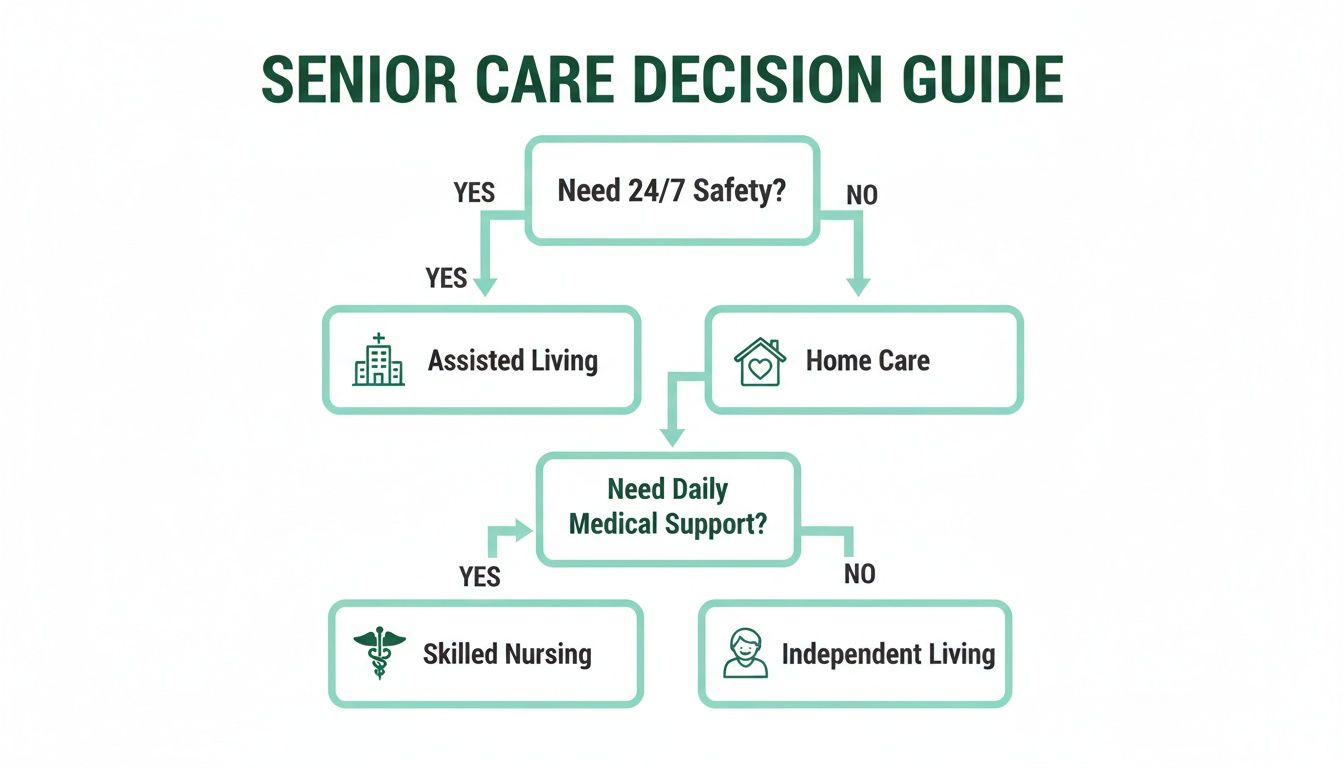
As the flowchart shows, if constant safety is your number one priority, an assisted living community offers the most direct and reliable solution.
Recent data shows a major shift toward community-based care. There are now 4.3 million jobs in these services compared to 3.3 million in institutional facilities. This trend makes sense when you see that 53% of family caregivers prefer in-home support, showing that the workforce is adapting to what families want. You can dig into more details about how the long-term care workforce has changed on the U.S. Bureau of Labor Statistics website.
Your Local Solution in Willis, Texas
For families in and around Willis, TX, who are leaning toward the benefits of a community setting, Forest Cottage Senior Care offers something special—a place that feels less like a facility and more like coming home. We blend professional, person-first care with an environment that's genuinely warm and inviting.
At Forest Cottage, we believe every moment matters. We provide comprehensive support—from medication management to social engagement—so families can stop being care coordinators and simply be family again.
Our approach is pretty straightforward:
- A True Homelike Environment: With private and shared rooms and cozy common areas, we create a real sense of belonging.
- Person-First Care: Every resident gets a personalized care plan that honors their dignity and respects their independence.
- All-Inclusive Support: We handle it all, from meals and housekeeping to coordinating with doctors and specialists.
Making the final call in the assisted living vs. home care debate is a personal journey. The best thing you can do now is see the options with your own eyes. We invite you to schedule a tour of Forest Cottage Senior Care to feel the difference a compassionate community can make. Let us help you find the perfect fit for your loved one.
Common Questions Families Ask About Senior Care
When you're weighing assisted living against home care, a lot of specific questions pop up. It’s completely normal. Here are some clear, straightforward answers to the concerns we hear most often from families, helping you feel more confident in your decision.
Can We Switch from Home Care to Assisted Living Later On?
Yes, absolutely. This is a path many families take. It's common to start with home care when the needs are less intensive. But as a loved one requires more consistent support, managing caregivers, schedules, and rising costs at home can become a real challenge.
Moving to an assisted living community is a natural next step. This shift often happens when families realize they need greater safety, more social engagement for their loved one, or the peace of mind that comes with 24/7 supervision—something that’s incredibly difficult to sustain at home. The key is recognizing when the level of care needed has outgrown what home care can practically offer.
How Does Personalization Work in Each Option?
Both models are built around personalized care, but they deliver it in different ways. Home care is personal by its very nature; a caregiver's time and attention are entirely dedicated to one person in their familiar surroundings for a set number of hours.
In an assisted living community, personalization is built into a carefully designed care plan.
When a new resident joins us, our team sits down with them and their family for a detailed assessment. We want to understand everything—health needs, personal preferences, what their daily routine looks like. That conversation becomes a living care plan that we review and update regularly, ensuring care is always tailored to the individual, even in a community setting.
What If My Loved One's Medical Needs Change?
Both home care and assisted living can adapt, but assisted living communities typically make these transitions much smoother. If a resident's health changes, the on-site team is already there to adjust the level of care, bring in new medical specialists, or integrate services like physical therapy or memory support right where they live.
With home care, a change in medical needs puts the responsibility back on the family. You have to find, vet, and hire new caregivers with specific skills, like a licensed nurse. This can create delays and stress, leaving potential gaps in critical medical support while you search for the right person.
Making the best choice is all about getting your questions answered. The team at Forest Cottage Senior Care is here to bring you that clarity. We encourage you to call us with any questions or schedule a personal tour to see firsthand how our community supports seniors right here in Willis, TX.