
The biggest difference between assisted living and a nursing home comes down to one simple thing: assisted living is all about social independence with a helping hand, while a nursing home delivers intensive, round-the-clock medical care. The right choice really depends on whether your loved one needs support with daily activities in a home-like setting or requires constant, skilled nursing in a more clinical environment.
Assisted Living vs Nursing Home: A Quick Comparison
Picking the right kind of senior care can feel like a huge weight on your shoulders, but once you understand the basic purpose behind each option, the decision gets much clearer. It helps to think of it like choosing between a supportive neighborhood and a specialized hospital. One is built for lifestyle and community, while the other is designed around medical necessity.
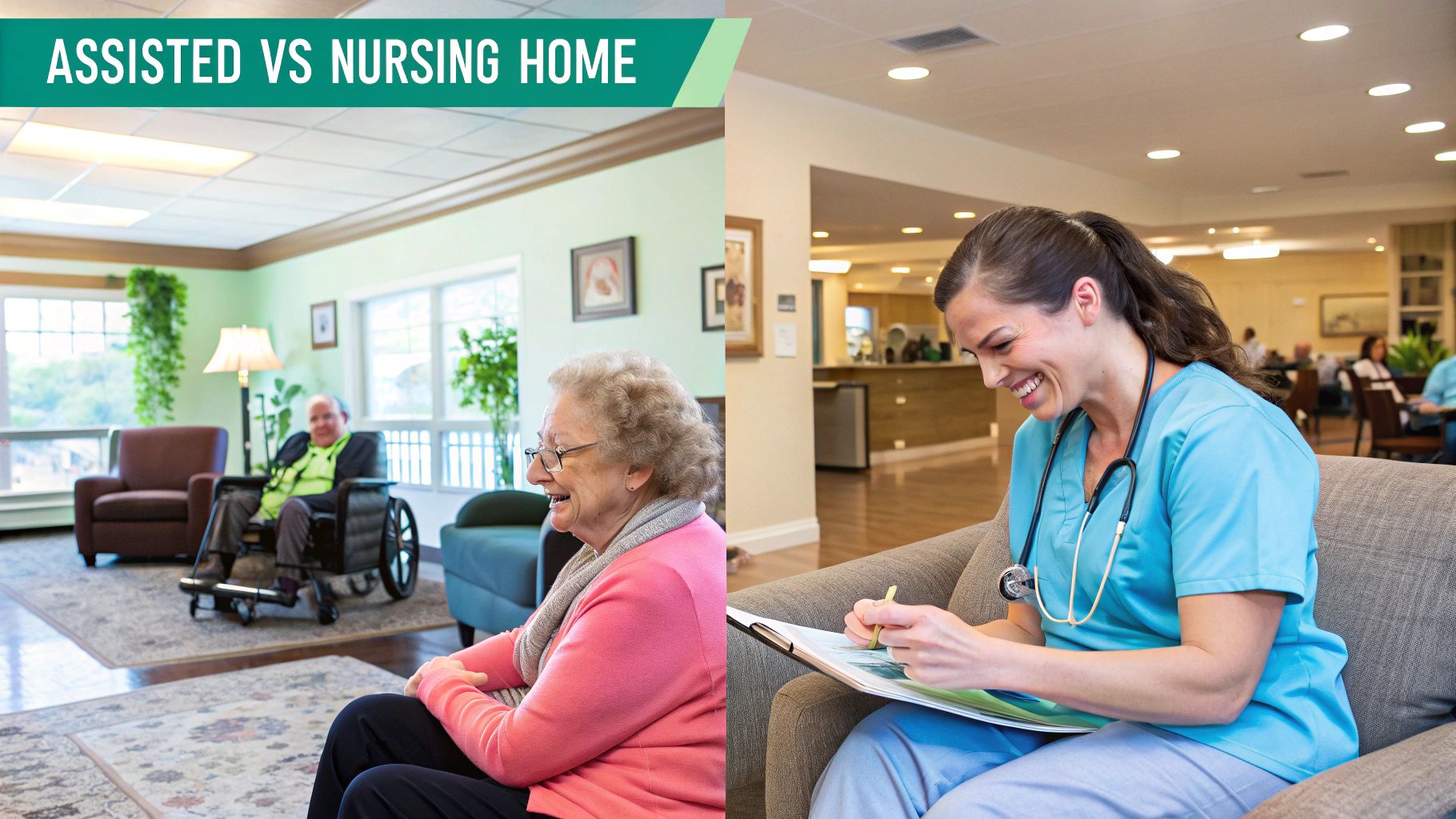
This distinction is more important than ever as families are looking for better senior living options. Modern communities, like us here at Forest Cottage Senior Care, really focus on a person-first approach. We work hard to create a genuine home-like setting that honors a resident's independence while making sure safety and support are always within reach.
Quick Comparison: Key Differences Between Assisted Living and Nursing Homes
To get a clearer picture of the contrast, it's useful to see the primary characteristics of each setting side-by-side. The table below gives you a snapshot of how these two models of care differ in their core mission, environment, and the services they provide.
| Feature | Assisted Living | Nursing Home (Skilled Nursing Facility) |
|---|---|---|
| Primary Focus | Social engagement, independence, and help with daily activities (ADLs). | 24/7 skilled nursing, medical treatment, and post-acute rehabilitation. |
| Environment | Residential, apartment-style living with shared dining and activity spaces. | Clinical, hospital-like setting often with shared rooms and medical equipment. |
| Medical Care | Medication management, health monitoring, and coordinating with outside doctors. | On-site licensed nurses, therapists, and physician-supervised care plans. |
| Ideal Resident | Seniors who need a hand with daily tasks but are otherwise mostly independent. | Individuals with complex medical conditions or those recovering from a major surgery. |
Seeing the options laid out like this really helps simplify things. It’s a practical way to start matching your loved one’s specific needs to the right environment.
The decision ultimately comes down to one question: Does your loved one need a supportive community to thrive, or do they require constant medical supervision to be safe? Answering this honestly is the first real step toward finding the right care.
Shifting Trends in Senior Care
The entire senior care landscape is moving toward models that put independence and quality of life first. It's no surprise that the global assisted living market is growing so quickly, valued at USD 4.52 billion in 2025 and projected to hit USD 8.60 billion by 2034.
This growth is a stark contrast to the nursing home sector, where the number of facilities has actually seen a small decline in recent years. If you want to dive deeper into the specifics of that model, you can check out our detailed guide on what is a nursing home.
Understanding the Two Models of Senior Care
When you start comparing assisted living vs nursing home options, it's easy to get lost in the details. But the most important thing to grasp is their core philosophy. One is built around a vibrant community that empowers residents, while the other is a clinical setting designed for complex medical needs. Getting this fundamental distinction right is the key to making the best choice for your family.
Assisted living is, at its heart, a residential community that champions independence and social connection. It’s for seniors who are still largely independent but could use a reliable support system for certain Activities of Daily Living (ADLs). The whole model is built to feel like home, where autonomy isn't just allowed—it's encouraged.
The services here are all about providing convenience and peace of mind, not constant medical oversight. At Forest Cottage Senior Care, for example, our support includes things like:
- Personalized Care: Helping with daily routines like dressing, grooming, and getting around safely.
- Medication Management: A gentle reminder system to make sure residents take the correct medications right on schedule.
- Chef-Prepared Meals: Nutritious, delicious food served in a social, restaurant-style dining room.
- Robust Social Programming: From our popular Goldendoodle pet therapy to local outings, we keep residents engaged and connected to the world around them.
This approach creates an environment where seniors don't just live; they thrive, because they get just the right amount of help. If this model sounds right, our guide explains in more detail what assisted living truly offers.
The Medically Focused Nursing Home Model
A nursing home, or what's officially called a Skilled Nursing Facility (SNF), operates on an entirely different model: a medical one. Its primary purpose is to care for people with significant health challenges who need constant clinical supervision from licensed professionals. Because of this, the environment is structured much more like a hospital, with the focus squarely on intensive medical treatment and rehabilitation.
Residents in a nursing home often have complex chronic illnesses, are recovering from a major surgery, or have conditions that demand skilled nursing attention around the clock. The decision to move to a nursing home is almost always driven by medical necessity, not lifestyle preference.
A nursing home is not a choice for lifestyle enhancement; it is a required setting for individuals whose medical needs have become too complex to be managed in a less clinical environment. This is the single most important differentiator.
Services in a nursing home are intensive and highly specialized. You'll find things like:
- Wound Care: Professional management of surgical wounds or chronic sores.
- IV Therapy: Administering medications or fluids intravenously.
- Intensive Rehabilitation: Daily physical, occupational, or speech therapy, often after a hospital stay.
- Palliative and Hospice Care: Coordinated end-of-life care under direct medical supervision.
A Clear Distinction in Population and Purpose
The numbers really tell the story of how different these two options are. Assisted living communities in the U.S. are home to just over 1 million residents, and 53% of them are over the age of 85. Nursing homes, on the other hand, serve about 1.24 million residents, reflecting the growing need for higher-level medical care in the senior population.
The stark cost difference—with assisted living averaging around $70,800 a year compared to the much steeper price of a nursing home—further highlights the divide between lifestyle support and intensive medical treatment. You can find more long-term care statistics that help paint a clearer picture of the landscape. Understanding this fundamental separation in philosophy, services, and cost is crucial for any family navigating their options.
A Day in the Life of Each Community
To really get a feel for the differences in the assisted living vs nursing home discussion, you have to look past the lists of services and imagine what a day is actually like in each place. The daily rhythm tells you everything about the philosophy of a community—whether it’s built around social independence or a more clinical structure. Let’s walk through a typical day in both settings. It’s the best way to see which one is the right fit.
A Morning Focused on Choice and Independence
In an assisted living community, the day starts with personal choice. Let's imagine a resident named Mary. She might wake up in her private apartment around 8:00 AM. A caregiver might stop by with a friendly reminder about her morning medication or offer a hand picking out an outfit, but the schedule is ultimately hers.
After getting ready, Mary can head down to the dining room for breakfast whenever she likes. She’ll have a menu to choose from and can sit with her friends. Her morning is wide open—maybe she’ll join a gentle yoga class, read a book in the library, or just sip her coffee on the patio.
The core of assisted living is empowerment. The day is a blank canvas for the resident. Staff provide the brushes and support needed to bring their vision to life, rather than dictating the entire picture.
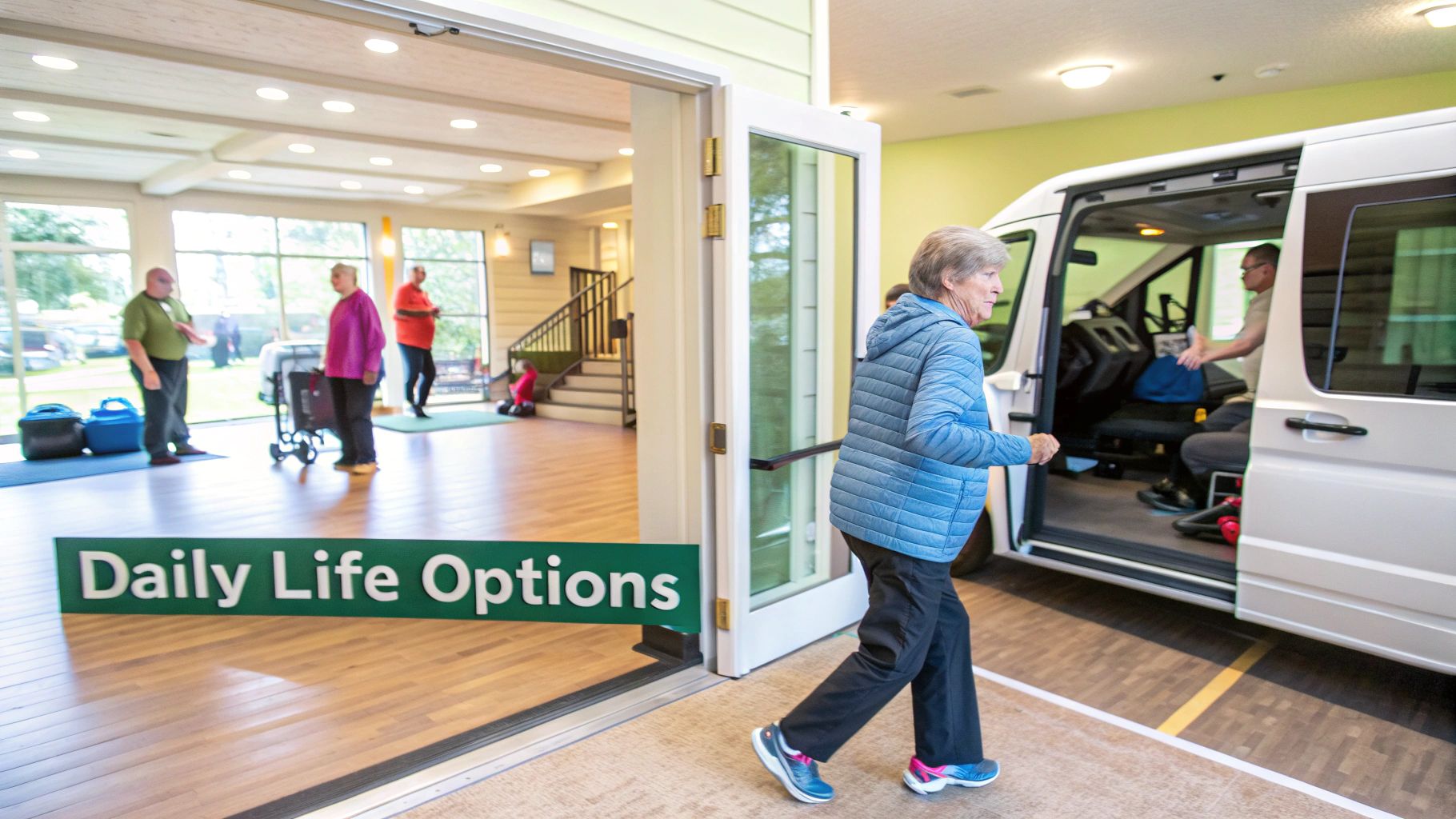
Later on, the community van might be heading out for a trip to a local store or a nearby park in Willis. Mary can sign up if she wants, staying connected to her community. It’s all about providing the support needed for an independent, engaging life. To get a better sense of how this works, you can explore the full range of our assisted living services, which are designed to support this exact kind of autonomy.
A Day Structured Around Medical Needs
Now, let’s picture a day for John, a resident in a skilled nursing facility. His day is much more structured because it’s built around his significant medical needs. A Certified Nursing Assistant (CNA) will likely wake him at a set time to help with bathing, dressing, and getting him ready for the day.
Breakfast is served at a specific time, usually in a shared room, to keep everything aligned with medication schedules and therapy appointments. John's morning is mapped out by his care plan:
- 9:00 AM: Physical therapy session to work on his mobility after a recent surgery.
- 10:30 AM: A nurse comes by to administer IV medication and check his vitals.
- 11:30 AM: Speech therapy to help with a swallowing issue.
Every part of John’s day is carefully managed by medical professionals. Social activities might be available, but they take a backseat to the main mission: providing continuous, skilled nursing care. Lunch and dinner are also served on a schedule to ensure residents get the right nutrition as part of their clinical oversight. This highly structured, medically-driven routine is what defines a nursing home, ensuring safety and health for people with complex conditions.
Navigating Costs and Payment Options for Senior Care
For most families, figuring out the financial side of senior care is the biggest hurdle. The costs and payment methods for assisted living vs nursing home options are worlds apart, and for good reason—they provide fundamentally different types of care. Knowing how you'll pay for either one is absolutely critical for long-term planning.
Think of assisted living costs as a straightforward monthly fee. This typically covers the essentials: room, board, meals, utilities, and a basic level of personal care. The model is built for flexibility, letting you add on more services as a resident's needs evolve over time.
Nursing homes, on the other hand, come with a much higher daily rate. That's because their fees bundle in comprehensive, 24/7 skilled nursing care, constant medical supervision, and often intensive rehabilitation services. It's a clinical care model, not a residential one, and the price reflects that.
How Assisted Living Is Typically Funded
When it comes to assisted living, the primary source of funding is private funds. Most families lean on personal savings, pensions, or the money from selling a home to cover the monthly bills. But don't stop there—several other resources can help ease the financial burden.
- Long-Term Care Insurance: Policies created specifically for senior care can be a huge help, though you'll find that benefits and coverage can vary dramatically from one plan to the next.
- Veterans' Benefits: The VA's Aid and Attendance benefit is a game-changer. It can provide a significant monthly stipend to eligible veterans and their surviving spouses to help with assisted living costs.
- Life Insurance Conversions: Some life insurance policies can be converted into a long-term care benefit plan, which provides monthly payments to go toward care.
The most important thing to remember about financing assisted living is that while it's mainly a private-pay system, you should explore every single supplemental option. So many families are surprised to discover resources like VA benefits that can make a real difference.
It's also worth noting that Medicaid's role is changing. While it won't cover room and board in assisted living, many states, including Texas, now offer Home and Community-Based Services (HCBS) waivers. These waivers can help pay for the care services part of the bill. If this sounds like a path for your family, our detailed guide explains how to determine if assisted living is covered by Medicaid.
Payment Sources for Nursing Home Care
The financial road to nursing home care is much more connected to government programs, simply because it’s considered a medical necessity. While you can pay privately, it's often not sustainable for the long haul, which leads many families to rely on Medicare and Medicaid.
Medicare plays a very specific and limited role. It will cover up to 100 days of skilled nursing care but only after a qualifying hospital stay of at least three days. This is designed for short-term rehab, not for someone needing chronic long-term care. And after the first 20 days, a hefty daily copayment kicks in.
Medicaid is the primary payer for long-term nursing home care in the U.S. To qualify, a person has to meet strict medical and financial requirements. This often means "spending down" personal assets to a certain level. It's a complex process, and families often look into strategies for protecting assets from nursing home costs with the help of legal experts to manage it correctly.
To make things a bit clearer, here’s a quick-reference table breaking down the common payment sources for each type of care.
Senior Care Payment Options at a Glance
This table breaks down the most common ways families pay for care, helping you see which paths are available for assisted living versus a nursing home setting.
| Payment Source | Commonly Used for Assisted Living | Commonly Used for Nursing Home |
|---|---|---|
| Private Pay (Savings, etc.) | Primary funding source | Used until assets are spent down for Medicaid eligibility |
| Long-Term Care Insurance | Yes, a common and effective tool | Yes, if the policy covers skilled nursing care |
| Medicare | No, does not cover assisted living | Yes, for short-term rehab (up to 100 days) |
| Medicaid | Limited (via state waivers for services) | Yes, the primary funder for long-term care |
| Veterans' (VA) Benefits | Yes, Aid and Attendance is a key benefit | Yes, for eligible veterans requiring skilled care |
Understanding these financial pathways early on can save you a world of stress. It allows you to plan ahead and ensure your loved one gets the right care without facing unexpected financial shocks.
How to Identify the Right Fit for Your Loved One
Choosing between assisted living and a nursing home feels a lot less overwhelming when you stop looking at lists of services and start thinking about real-world situations. The clearest way to make a decision is to paint a picture of the ideal person for each environment. Once you understand these distinct profiles, you can see which one more closely matches your loved one’s day-to-day reality.
This is all about matching the level of care to the individual's life. Is the main need for a social boost and a little help, or is it for constant, hands-on medical care?
The Ideal Assisted Living Resident
Picture someone who is still fairly independent but is starting to find some daily tasks a bit much. Let’s call her Eleanor. She lives alone, and while she’s mobile and sharp, she sometimes forgets her medication and finds cooking three meals a day draining. Eleanor is also feeling more isolated since her best neighbors moved away and she stopped driving.
Eleanor is the perfect candidate for assisted living. She doesn't need a nurse on call 24/7, but she would absolutely thrive with:
- Help with Daily Activities: Gentle medication reminders and a hand with housekeeping would lift a huge weight off her shoulders.
- Social Connection: A community with planned activities and shared meals would be the perfect cure for her loneliness.
- A Sense of Autonomy: She can keep her independence in a private apartment but have the peace of mind of a support system just down the hall.
For someone like Eleanor, a nursing home would feel overly restrictive and unnecessary. Assisted living strikes the right balance between support and freedom. You can find more clarity in our guide on how to know when your parents need assisted living.
The Ideal Nursing Home Resident
Now, think about Robert. He recently had a major stroke that left him with serious mobility challenges and trouble swallowing. He needs a feeding tube and requires consistent physical therapy to build back his strength. His medical situation is complex and needs to be managed by skilled nursing professionals around the clock.
Robert’s needs clearly point to a nursing home, which is also known as a skilled nursing facility. What he needs goes far beyond what assisted living is built to handle. He requires:
- 24/7 Skilled Nursing Care: His condition requires constant attention from licensed nurses who can manage his feeding tube and watch for any complications.
- Intensive Rehabilitation: Having physical, occupational, and speech therapists on-site is non-negotiable for his recovery.
- Comprehensive Medical Management: His care plan is intricate and must be directed by a physician and executed by a full clinical team.
For Robert, assisted living simply wouldn't be safe or appropriate. His needs are fundamentally medical, making a skilled nursing facility the only sensible choice.
The core of the assisted living vs. nursing home decision is this: you are choosing between a residential community designed for social wellness and a medical facility designed for clinical necessity. One supports lifestyle, while the other manages complex health conditions.
The decision tree below gives you a simple visual guide to help walk through the financial and care-level factors for each option.
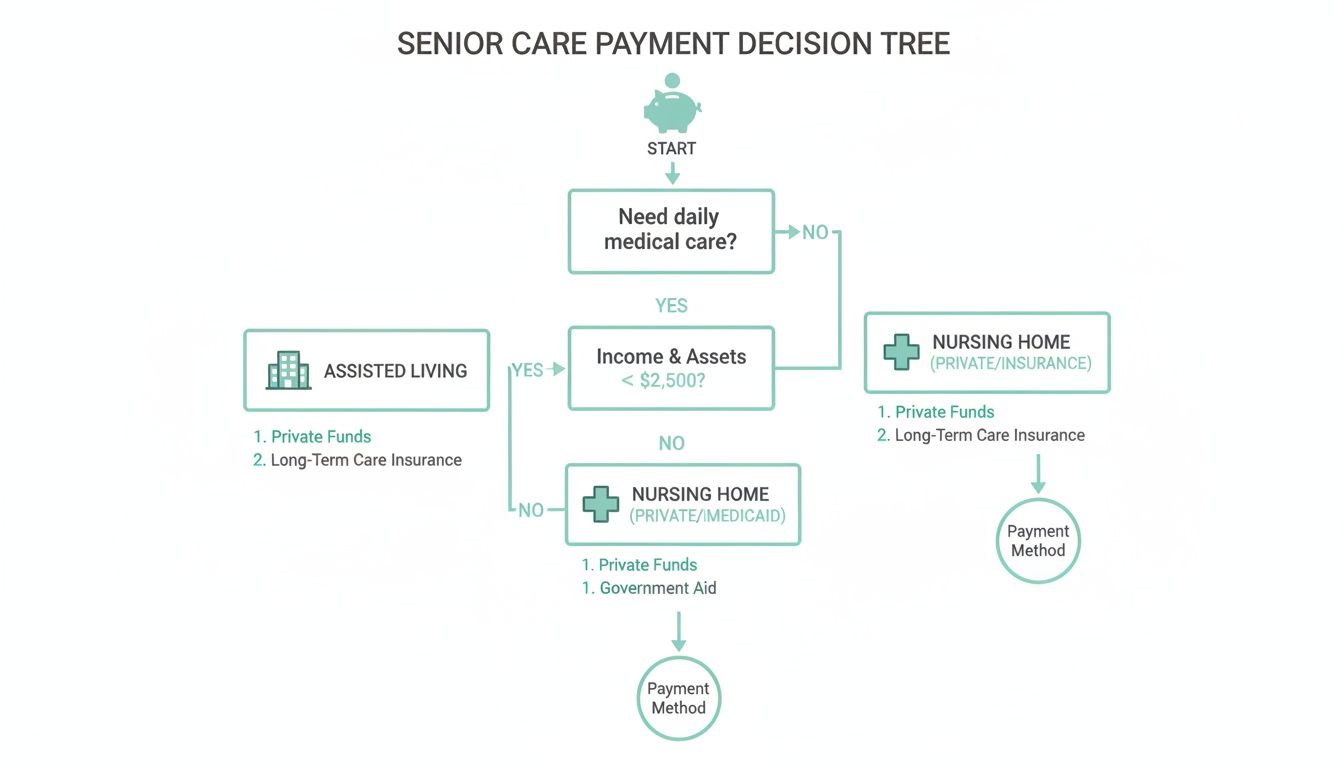
This visual helps clarify how payment options often line up with the level of care, guiding families toward the right financial strategy from the get-go.
Demand for both types of care is on the rise, but for different reasons. Projections show a 'Silver Tsunami' heading for nursing homes, with an estimated need for over 3,000 new facilities by 2030 to handle a 23% jump in the 65+ population. Meanwhile, assisted living offers a different kind of solution, with average stays of 22 months where residents can manage common conditions like high blood pressure in a supportive, less clinical setting. To further explore your options and determine the best fit for your situation, resources are available to help you make an informed decision.
Discover Person-First Care at Forest Cottage in Willis
Trying to figure out the difference between assisted living vs. nursing home care can be a real headache, but once you understand the core philosophies behind each, the right path usually becomes much clearer. For families here in Willis, TX, who are looking for a community that prioritizes independence, dignity, and truly personalized support, assisted living is often the answer. Forest Cottage Senior Care is built on this person-first model, offering a genuine home where every single resident matters.

We've worked hard to create a vibrant, homelike environment that feels worlds away from the clinical structure of a typical nursing home. Our approach is specifically for seniors who need a helping hand with daily activities but don't require the kind of intensive, 24/7 medical supervision found in a skilled nursing facility. It's a critical distinction, and it's key to helping our residents hold onto their sense of self and autonomy.
Tailored Support for Every Stage
We know that everyone's journey is different. That's why you won't find any one-size-fits-all care plans here. Instead, we carefully craft a plan for each resident, and it’s designed to scale and adapt over time.
- Semi-Assisted Living: This is perfect for someone who's still quite independent but would find life a little easier with help in areas like meal preparation, housekeeping, and medication reminders.
- Full Assisted Living: We offer comprehensive support with Activities of Daily Living (ADLs), which can include things like bathing, dressing, getting around, and personal hygiene.
- Memory Support: We provide specialized, compassionate care for residents living with memory loss, ensuring their safety and quality of life in a secure and understanding setting.
This flexibility means that as a resident’s needs evolve, their home and community can evolve right along with them. That continuity provides incredible peace of mind for both the residents and their families.
At Forest Cottage, we bridge the gap between complete independence and intensive medical care. We provide a supportive environment where residents receive exactly the help they need without sacrificing the freedom and dignity they deserve.
More Than Just Care It Is a Community
Whether you're an adult child looking for the best for your parent, a veteran seeking a supportive community, or a local senior wanting to stay connected to Willis, Forest Cottage offers a solution rooted in real compassion. We firmly believe that exceptional care goes way beyond just physical support.
Our 24/7 nursing staff is always on hand for immediate needs and health monitoring, which offers a level of security that brings a lot of comfort. But our commitment extends to nurturing the spirit, too. Between our chef-prepared meals, engaging social programs, and our beloved Goldendoodle pet therapy, we focus on creating moments of joy and connection every single day.
We also try to simplify life for everyone by including transportation and beautician services at no extra cost. No hidden fees, no hassle—just making life a little easier.
Take the Next Step with Confidence
Making the right decision for senior care always starts with a simple conversation. We invite you to come and experience the warmth and dedication of our community for yourself. See firsthand how Forest Cottage Senior Care offers a loving, person-first alternative to nursing home care.
Contact us today to schedule a personal tour or request a complimentary care assessment. Let us help you find the perfect fit for your loved one, right here in the heart of Willis.
Common Questions We Hear About Senior Care
It’s completely normal to have a lot of specific, practical questions when you start looking into senior living. Even after you understand the main differences between assisted living vs nursing home care, the smaller details can still feel confusing. Here are some straightforward answers to the questions we hear most often from families right here in the Willis community.
Can a Resident Move from Assisted Living to a Nursing Home?
Yes, absolutely. This is a very natural and common step for some seniors. While assisted living communities are built to support residents through many stages of aging, there can come a time when their medical needs become too complex for the facility to handle.
If someone requires round-the-clock skilled nursing care—maybe for a complicated, chronic illness or after a major health event—a move to a nursing home is the right and necessary step for their safety. A good assisted living community will always work hand-in-hand with the resident, their family, and their doctors to make that transition as smooth and caring as possible. The priority is always to ensure they get the right level of care in the right place.
What Is the Key Difference in Staff Training?
This is one of the biggest distinctions between the two, and it really gets to the heart of what each one is designed to do. The training and qualifications of the staff directly match the level of care provided.
- In Assisted Living: The caregivers you'll interact with most are often Certified Nursing Assistants (CNAs) or specially trained resident aides. Their expertise is in helping with the Activities of Daily Living (ADLs)—things like dressing, bathing, and getting around safely. There's typically a licensed nurse (an LPN or RN) on-site or on-call to handle medications and keep an eye on everyone's general health.
- In a Nursing Home: The team is led by a much larger group of licensed medical professionals. You'll find Registered Nurses (RNs) and Licensed Practical Nurses (LPNs) on duty 24/7. They're there to manage complex medical treatments, IVs, and post-surgery care, while CNAs help with the more personal support tasks.
How Do We Know It Is the Right Time for Senior Living?
This is easily one of the hardest questions a family has to answer. There's no magic signal, but you can look for clear patterns that show it’s time to start seriously exploring a more supportive setting. It’s usually not about one single incident but an accumulation of small things.
The right time is often when the challenges of living at home begin to outweigh the comforts. It's not about one bad day, but a consistent decline in safety, social connection, or personal care that signals a need for change.
Have you noticed they've lost weight, or their personal hygiene isn't what it used to be? Are there unexplained bruises from falls? Maybe they seem more isolated and lonely than ever before. If you find yourself constantly worried about their safety or well-being, that's your cue. It’s a strong sign that it’s time to find a solution that gives everyone peace of mind.
At Forest Cottage Senior Care, we know these questions are just the start. We're here to give you the honest answers and guidance you need to make a choice for your family that feels right.