

When you first ask, "how much is assisted living," you'll likely hear the national average, which currently hovers around $5,350 per month. But that number is just a starting point. Think of it as the sticker price on a car—it doesn't account for the features, location, or level of service that ultimately determine the final cost.
Here in Texas, the range is often quite similar, which makes it all the more important to dig a little deeper and understand exactly what you're paying for.
Understanding the True Cost of Assisted Living

I've found the best way to explain assisted living costs is to compare it to booking a vacation. You could go the 'a la carte' route, paying separately for your hotel room, every meal, and each activity. Or, you could choose an all-inclusive resort where one predictable fee covers just about everything—lodging, dining, entertainment, and any support you might need.
Assisted living communities are a lot like that all-inclusive resort. The monthly fee isn't just rent for an apartment; it bundles all the essential services and amenities into a single, manageable payment. This approach makes budgeting far simpler and gives families peace of mind knowing there won't be a stack of surprise bills at the end of the month.
What Is Typically Included
While every community has its own unique offerings, most all-inclusive monthly fees are designed to cover everything needed for a safe, comfortable, and engaging lifestyle.
Here’s what you can generally expect to be covered:
- Housing: A private or semi-private apartment or suite.
- Dining: Three nutritious, chef-prepared meals each day, usually served in a social, restaurant-style dining room.
- Utilities: All the basics are handled, like electricity, water, heating, and often even cable and Wi-Fi.
- Support Services: No more worrying about chores! Housekeeping, laundry, and general maintenance are all taken care of by the staff.
- Care: This is the core of assisted living—hands-on help with activities of daily living (ADLs), all based on a personalized care plan.
The assisted living market is growing fast. It was valued at USD 157.28 billion in 2023 and is projected to climb to USD 271.50 billion by 2032. For families in Texas, this growth means more choices, but it also highlights just how crucial it is to find a community where the cost truly aligns with the care provided.
The real value of assisted living isn't just in the services it provides, but in how it combines housing, personalized care, and social connection into one predictable monthly cost. It removes the enormous financial and logistical headaches of trying to manage all those things separately at home.
Personalized Care Affects the Price
In communities like Forest Cottage Senior Care right here in Willis, Texas, the entire approach is built around personalized care. This is key because it means you only pay for the specific support your loved one actually needs.
It all starts with a thorough assessment. From there, we create a custom care plan that addresses individual requirements, which ensures the assisted living cost per month accurately reflects the services being provided. This method keeps families from paying for unnecessary assistance and gives everyone a clear, predictable financial roadmap for the future.
What Your Monthly Fee Actually Covers
When you see that single monthly price tag for assisted living, it's easy to wonder what’s really packed into that number. It’s so much more than just rent. Think of it less like an apartment lease and more like an all-inclusive membership to a lifestyle free from chores and full of support.
This one fee bundles all the core necessities of daily life, which means no more juggling separate bills for housing, utilities, groceries, and entertainment. That predictability is a huge relief for families trying to figure out the real monthly cost of assisted living. You're not just paying for a room; you're investing in a complete support system designed for total well-being.
The Core Components of Your Monthly Fee
At its heart, the monthly fee takes care of the foundational things that make life comfortable and secure. These are the services that replace the daily grind of homeownership, freeing up your loved one’s time and energy to focus on what they actually enjoy.
Most communities, including ours at Forest Cottage, build their pricing around these absolute essentials:
- Private or Shared Living Space: This is their personal apartment or suite—a private sanctuary within the larger community.
- Restaurant-Style Dining: This typically covers three nutritious meals a day. They’re prepared by chefs and served in a social dining room, which means no more grocery shopping, cooking, or cleaning up.
- All Essential Utilities: Say goodbye to separate bills for electricity, water, heat, and trash. Many communities even roll basic cable and Wi-Fi into the package.
- Housekeeping and Laundry Services: Regular cleaning of their living space and personal laundry services are standard, keeping their home clean and pleasant without the physical strain.
- Home and Grounds Maintenance: No more worrying about a leaky faucet, mowing the lawn, or shoveling snow. The community staff handles all of that.
The real "aha!" moment comes when you add up what all these services would cost if you paid for them one by one at home. When you tally up a mortgage, utilities, groceries, a cleaning service, and home repairs, that all-inclusive fee often looks surprisingly reasonable.
Beyond the Basics: Amenities for a Thriving Life
While the core services cover safety and comfort, the true spirit of assisted living shines through in the amenities that foster connection, health, and happiness. These are the things that turn a residence into a real community and fight the isolation that so many seniors face when living alone.
These enriching services are a critical part of what your monthly fee is paying for. They ensure residents aren't just safe, but are also active and engaged. For a deeper look into these offerings, you can explore the full range of what services are included in assisted living to see just how much they add to a fulfilling lifestyle.
For example, a community like Forest Cottage aims for a resort-style experience by including things like:
- Social and Recreational Programs: A full calendar of activities, from fitness classes and art workshops to book clubs and get-togethers, keeps everyone mentally and physically engaged.
- Wellness Activities: These are programs specifically designed to support physical, emotional, and cognitive health, promoting a proactive approach to feeling good.
- Scheduled Transportation: Reliable rides to medical appointments, shopping trips, and community outings mean residents stay connected to the wider world without the stress of driving.
These bundled amenities do more than just fill a schedule. They create daily opportunities for friendship, purpose, and joy—invaluable ingredients for a high-quality life in the senior years.
How Different Levels of Care Shape the Final Price
When families ask, "How much is assisted living?" the wide price range can be confusing. The single biggest reason for that variation comes down to one crucial factor: the level of care your loved one actually needs.
Think of it like a subscription plan for support. You wouldn't pay for a premium movie package if you only watch local channels, right? It's the same principle here. You choose the level that matches the specific help someone requires, ensuring you never overpay for services they don't use.
This personalized approach is the key to understanding the final monthly bill. Someone who's mostly independent and just needs a little help with medications will have a very different price point than a resident who needs hands-on assistance with daily routines like bathing, dressing, and getting around safely. This tiered system is what makes pricing fair and accurate, moving away from a flat fee to a structure that truly reflects an individual's needs.
The Initial Care Assessment
Before anyone moves into a community like Forest Cottage, our team conducts a careful and thorough assessment. This isn't just a formality; it's a conversation. We work with the family and, whenever possible, the incoming resident to create a detailed, personalized care plan from the ground up.
This plan becomes the blueprint for their care, outlining exactly what kind of support is needed. It covers everything from managing medications to help with personal hygiene, making sure the care level—and therefore the cost—is precisely aligned with their current abilities and health.
By tailoring the care plan from day one, communities can provide exactly what's needed without charging for a bundle of services that a resident might never use. This transparency is key to building trust and making sure the monthly fee is both fair and predictable.
The worldwide assisted living sector, valued at USD 4.52 billion in 2025, is projected to nearly double to USD 8.60 billion by 2034. This explosive growth is driven by the rising demand for personal care services—the very hands-on assistance this personalized approach is designed to deliver. At Forest Cottage Senior Care in Willis, Texas, our plans are built to scale, from light supervision to more comprehensive support.
Understanding the Tiers of Care
While the exact names might change from one community to another, the levels of care generally follow a pretty logical path from minimal support to more intensive help. This structure helps families see exactly how an increase in needs translates to an increase in cost.
The monthly fee is really a bundle of housing, meals, and that all-important element of care, as this graphic shows.
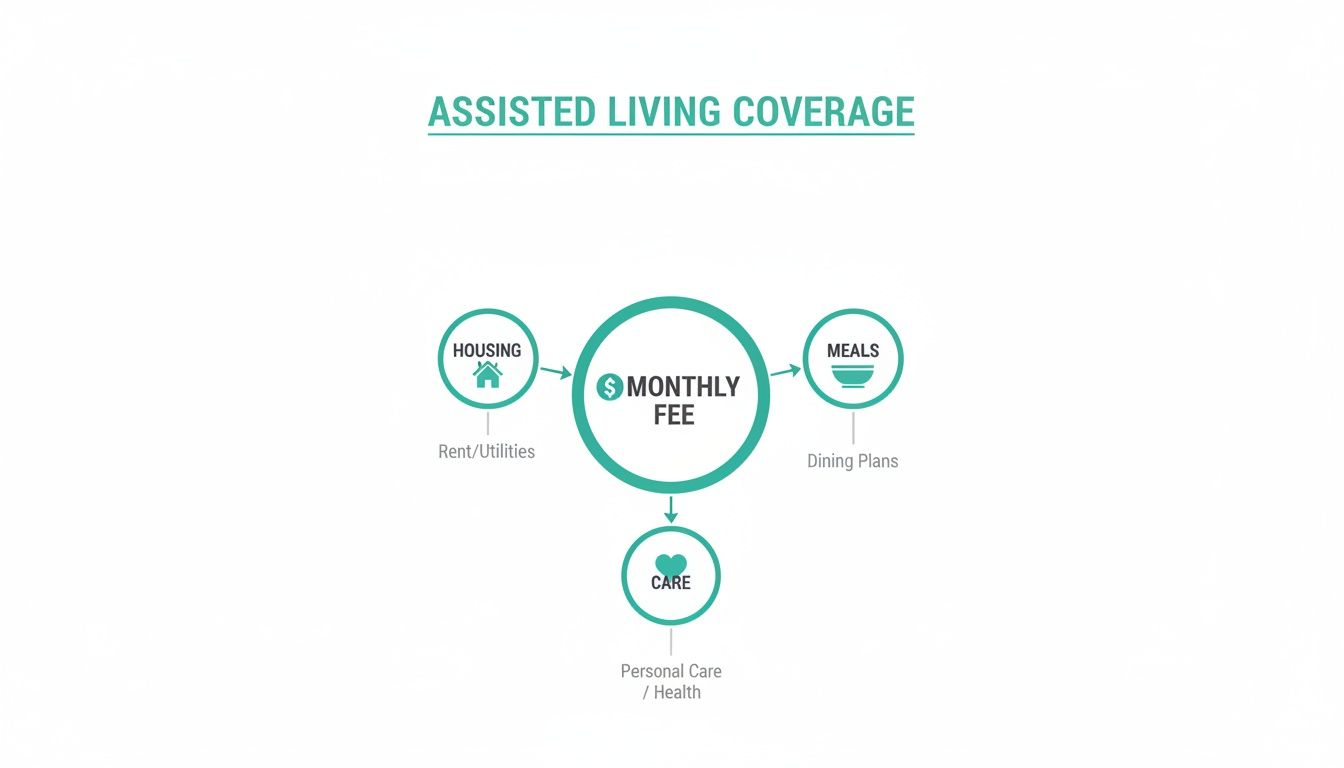
As you can see, care is a core part of the package, and its cost is tied directly to the level of support a resident receives.
To make this clearer, we've broken down how different care levels impact the monthly cost and who they're best suited for.
Comparing Levels of Care and Associated Costs
This table illustrates how different levels of care directly influence the monthly cost, showing what services are typically included at each tier.
| Level of Care | Typical Services Included | Estimated Monthly Cost Add-on | Ideal For |
|---|---|---|---|
| Level 1: Light Support | Meal preparation, housekeeping, social activities, medication reminders, weekly wellness checks. | $300 – $700 | Seniors who are mostly independent but want the convenience and safety of community living. |
| Level 2: Moderate Assistance | All Level 1 services, plus hands-on help with one or two daily activities like dressing or grooming. | $700 – $1,500 | Individuals who need a bit of regular, hands-on help but can manage most of their day on their own. |
| Level 3: Comprehensive Care | All Level 1 & 2 services, plus daily, significant support with multiple activities like bathing, mobility, and transferring. | $1,500+ | Residents who require consistent, daily assistance to stay safe and healthy. |
Each step up involves more one-on-one time and direct support from trained staff, which is reflected in the cost. This ensures the pricing is always fair and directly related to the services provided.
Specialized Memory Care
For seniors living with Alzheimer's disease or other forms of dementia, a specialized level of care is often essential. Memory care is typically the highest tier of assisted living and comes with a higher price tag—but for very important reasons.
These dedicated environments offer a higher staff-to-resident ratio, enhanced security to prevent wandering, and structured programs designed to support cognitive function and reduce agitation. The staff also receives specialized training in dementia care. It's a crucial distinction, and you can learn more about the unique benefits by exploring the differences between memory care vs assisted living and why the added cost is truly an investment in safety and quality of life.
Ultimately, the level of care is the engine that drives the final cost of assisted living. By understanding how these tiers work, you can make a much more informed decision and find a community that offers the perfect balance of support and value for your family.
Financial Strategies for Paying for Assisted Living
Figuring out the numbers is step one. But the next, and often biggest, question is: how do we actually pay for this? It’s pretty rare for one single source to cover everything. Instead, think of it like creating a financial mosaic—piecing together different resources to build a solid, sustainable plan.
This is your playbook. We're going beyond just dipping into savings and exploring some powerful, often overlooked strategies that can make quality care truly affordable. From leveraging military service to unlocking the value in assets you already have, there are more paths forward than you might think.
Unlocking Veterans Benefits for Assisted Living
For veterans and their surviving spouses, one of the most powerful tools is the VA's Aid and Attendance pension. This isn't a benefit that just shows up; you have to know about it and apply for it. It provides a substantial monthly, tax-free payment that can go directly toward assisted living costs.
This benefit is specifically for veterans who served during wartime and now need a hand with daily activities like bathing, dressing, or managing their medications. At communities like Forest Cottage, we see firsthand just how transformative this support can be.
The Aid and Attendance benefit is an absolute game-changer for eligible veterans. It often closes that financial gap that makes professional care feel just out of reach. It's a benefit earned through service, and our team is passionate about helping families get through the application process.
Eligibility for Aid and Attendance hinges on a few key criteria:
- Service Requirement: The veteran must have served at least 90 days of active duty, with at least one day during a period of war.
- Medical Need: The applicant must need help from another person to handle daily personal tasks.
- Financial Thresholds: The applicant has to meet specific income and asset limits set by the VA.
The application can feel a bit daunting, which is why communities like Forest Cottage actively help families gather the right documents and connect them with resources to make the process as smooth as possible.
Leveraging Insurance and Home Equity
Beyond military benefits, many families have powerful financial tools already at their disposal. They're often hiding in plain sight in the form of insurance policies or home equity. These assets can be converted into a reliable income stream to fund long-term care.
Long-Term Care Insurance
This is the most direct way to plan for future care. A long-term care insurance policy is designed for exactly this purpose—to cover the costs of services like assisted living. If you or your loved one has a policy, now is the time to dust it off, review the benefits, and understand how to file a claim.
Life Insurance Policies
Here's something many people don't realize: a life insurance policy can be used while the policyholder is still living. Through what's known as a "life settlement" or by accessing its cash surrender value, you can convert a policy into a lump sum of cash. This can provide the immediate funds needed for move-in fees and cover the first several months of care.
Reverse Mortgages
For homeowners age 62 or older, a reverse mortgage lets you turn part of your home's equity into cash payments. This can create a steady monthly income to help pay for assisted living without having to sell the house right away. This is a big financial decision with long-term consequences, so it's critical to talk it over with a trusted financial advisor.
Other Funding Sources to Consider
It’s so important to look at every available resource to create a strong financial plan. Most families find that combining several sources is the most effective way to go.
While Medicare generally doesn't cover long-term assisted living, you shouldn't overlook Medicaid. If you want to know more, you can learn all about how Medicaid pays for assisted living in our detailed guide: http://44.202.110.106/does-medicaid-pay-for-assisted-living/
For anyone worried about the long-term financial impact, a comprehensive Texas Medicaid planning guide for protecting assets from nursing home costs can offer strategies that are also relevant for assisted living.
Finally, don't underestimate the power of personal assets. These can include:
- Retirement Funds: Money from a 401(k) or an IRA is very often used to pay for care.
- Annuities: These can provide a guaranteed stream of income for a set amount of time.
- Home Sale: Selling the family home is a common strategy that often provides the bulk of the necessary funds.
By exploring all of these avenues, you can build a solid financial foundation for this important next chapter.
Smart Tips for Making Assisted Living More Affordable
Figuring out the cost of assisted living is one thing, but making that number fit into your family’s budget is the real challenge. The good news? Finding high-quality care that’s also affordable is entirely possible if you know where to look. It’s not about cutting corners on care, but about making smart, informed choices that stretch your dollars.
Many families don’t realize that some of the best savings can be found right within a community’s own offerings. With a few insider tips, you can often bring that monthly bill down quite a bit, all while securing a wonderful home for your loved one.
Look Beyond the Private Room
The single most direct way to lower the monthly fee is to consider a companion suite or a semi-private room. While everyone loves the idea of a private apartment, a shared space can often slash the housing portion of your bill by 20-30% or even more. It's one of the biggest financial levers you can pull.
And it's not just about the money. A companion suite comes with a built-in social life, which can be a powerful antidote to the loneliness some seniors feel when they first move. Having a roommate means an instant friend for meals, activities, and daily chats—enriching their whole experience in ways you might not expect.
Understand the Pricing Model
Not every assisted living community bills the same way. It's so important to get clear on whether you’re looking at an all-inclusive price or an 'a la carte' menu to avoid any nasty surprises down the road.
- All-Inclusive Pricing: This bundles housing, meals, utilities, and a set package of care services into one monthly payment. It's predictable, which is great for budgeting, but you need to know exactly what that "base" level of care includes.
- 'A La Carte' or Fee-for-Service: With this model, you pay a base rent and then add on costs for each service you use, whether it’s help with medications or getting dressed in the morning. This can work out cheaper for very independent seniors, but the costs can climb quickly as care needs grow.
At Forest Cottage, we believe you deserve to know exactly what you’re paying for. We lay everything out clearly, so you see where your money is going and can be confident there are no hidden fees waiting for you.
Ask for a complete, itemized list of all potential charges—everything from incontinence supplies to transportation for a doctor's appointment. A community that’s serious about transparency will have no problem giving you this, helping you build a realistic budget.
Actively Seek Out Savings Opportunities
Finally, don't ever hesitate to ask about special offers or ways to trim the bill. Communities often have programs designed to make the transition a little easier on your wallet.
Here are a few questions you should always ask:
- Are there any move-in specials? Some communities might waive the one-time community fee or offer the first month at a lower rate to get you in the door.
- Can certain fees be negotiated? While rent and care fees are typically set in stone, things like pet fees or second-person fees might have some flexibility. It never hurts to ask.
- Which amenities are optional? You might be able to save a few dollars each month by opting out of services you don’t need, like a personal landline or premium cable channels.
By being proactive and exploring these strategies, you put yourself in the driver's seat. You'll be able to make a confident financial decision and find a wonderful community that fits your budget.
Finding the Right Community in Willis Texas

You’ve done the hard work of understanding the costs, care levels, and ways to pay. Now it's time to translate all that knowledge into a confident decision. Finding the right community here in Willis, Texas, really comes down to a few clear, practical steps.
Think of this as your final checklist. It’s about moving from spreadsheets and research to seeing, feeling, and truly knowing you’ve found the right place. Each step builds on the last, leading you to a community that not only fits the budget but also feels like home.
Your Roadmap to a Confident Choice
The journey to find the perfect assisted living community doesn’t have to be overwhelming. All it takes is a simple, structured approach to narrow down your options and make sure a community’s promises line up with its reality.
Here's a straightforward, four-step roadmap we recommend:
Start with a Professional Assessment: Before you tour anywhere, get an objective, professional care assessment for your loved one. This gives you a clear baseline of their needs, so you know exactly what level of support you're looking for from the very beginning.
Schedule In-Person Tours: A website tells you what they want you to see; a visit shows you what’s real. Pay close attention to the atmosphere. Do the residents seem happy and engaged? Is the staff warm and welcoming? You can feel the difference.
Get a Detailed Cost Sheet: Never, ever settle for a verbal quote. Ask for a written, itemized breakdown of every single charge. This transparency is non-negotiable for understanding how much is assisted living will truly cost each month, without any unwelcome surprises.
Discuss All Financial Avenues: Sit down with the community’s financial advisor or director. Go over every payment option, from private funds to VA benefits, to ensure you have a solid and sustainable financial plan in place.
Your final decision shouldn’t feel like a transaction. It should feel like you’re joining a family. The right community will be an open book, ready to answer every single question with clarity and compassion, making you feel supported long before move-in day.
Making Your Next Step Easy
A huge part of this process is simply knowing which questions to ask. To help you cover all your bases, our guide on questions to ask assisted living facilities is an invaluable resource to print out and take with you on your tours.
Here at Forest Cottage Senior Care, we pride ourselves on providing that clarity and support. We invite you to connect with our team. Let us help you with a personalized assessment and a completely transparent look at your options, making your next step feel both easy and right.
Got Questions About Assisted Living Costs? We've Got Answers.
Even after you've crunched the numbers, a few more questions always seem to pop up as you get closer to making a decision. It’s completely normal. Let’s tackle some of the most common concerns families have about paying for assisted living so you can move forward with confidence.
Does Medicare or Medicaid Cover Assisted Living in Texas?
This is easily the number one question we hear, and the answer isn't a simple yes or no.
Let's start with Medicare: it does not cover the long-term room and board costs of assisted living. Think of Medicare as your health insurance—it’s there for doctor visits, hospital stays, and prescriptions, but it won’t pay the monthly rent at a senior living community.
Medicaid is a different story. For low-income seniors in Texas, the STAR+PLUS waiver program can be a huge help. It can pay for the care services a resident receives in an assisted living community. However, it won't cover the cost of the apartment or meals (the "room and board"). So, while Medicaid can significantly reduce the monthly bill, the resident is still responsible for the housing portion.
What's the Difference Between Assisted Living and a Nursing Home?
It really comes down to independence versus intensive medical care.
Assisted living is for seniors who could use a hand with daily activities—like managing medications or getting ready for the day—but don't need a nurse watching over them 24/7. The entire focus is on supporting an independent, active lifestyle in a comfortable, home-like setting.
A nursing home, also called a skilled nursing facility, provides a much higher, hospital-like level of medical care. It's the right choice for individuals with serious health conditions who need constant monitoring and treatment from licensed nurses.
The heart of assisted living is offering just enough support to help a senior thrive on their own terms. A nursing home is for when medical needs become the top priority, requiring around-the-clock clinical care.
Can We Deduct Assisted Living Costs on Our Taxes?
In many situations, the answer is yes. If your loved one is in assisted living primarily for medical care and needs help with at least two Activities of Daily Living (ADLs), a large part of their costs can often be deducted as medical expenses.
The IRS allows deductions for qualified long-term care services, which includes the cost of personal care needed by someone who is chronically ill. Of course, it’s absolutely essential to talk this over with a tax advisor. They can look at your specific situation and tell you exactly what portion of the monthly fees qualifies and how to claim it correctly. Be sure to keep meticulous records from the community!
At Forest Cottage Senior Care, we help families sort through these questions every single day. Our team is committed to giving you transparent answers and clear guidance so you have a complete financial picture. Schedule a visit with us today and get the clarity you deserve.