

Starting a conversation about assisted living with your parents requires a gentle touch. The secret is to lead with love and concern, pick a quiet moment, and approach it as a team effort to plan for their future happiness and safety. Keep the focus on the benefits of having more support, not on what they might be giving up.
Laying the Groundwork for a Compassionate Conversation
Bringing up assisted living is rarely a single, sit-down discussion. It’s a process, one that needs to be built on a foundation of empathy and thoughtful planning. This first conversation really sets the tone for everything to come. It’s your chance to show your parents you’re in their corner, acting as their advocate to make sure their well-being is protected and their wishes are front and center.
The goal here isn't to push them into a decision. It's simply to open the door to a dialogue. Many older adults have an outdated picture of "senior living," imagining sterile, clinical places. Today’s communities are the complete opposite—they’re vibrant, supportive environments designed to make life better.
The PREP Method for Initiating the Assisted Living Talk
To keep the conversation loving and productive, it helps to have a gentle framework in mind. I've found that the PREP method provides four key pillars to guide that initial talk, helping you stay focused on what truly matters: your parent's comfort and security.
It's a simple, memorable way to organize your thoughts and intentions.
| Pillar | Description | Example Action |
|---|---|---|
| Patience | Recognize this is a huge life change. Avoid rushing things, and be ready to have this conversation more than once. | "Mom, there's absolutely no rush, but I'd love for us to start talking about what the future might look like for you." |
| Respect | Honor their feelings and their right to make their own choices. Validate their concerns so they feel heard and in control. | "I know you're worried about losing your independence. Let's look at options that actually help you keep as much of it as possible." |
| Empathy | Try to see it from their perspective. Imagine their fears about aging, change, and leaving a home filled with a lifetime of memories. | "I can only imagine how hard this is to even think about. Your feelings are completely understandable." |
| Planning | Frame this as proactive planning for the future, not a panicked reaction to a crisis. The focus is on being prepared. | "I just want to make sure we have a plan in place that you're happy with, so we aren't forced to make rushed decisions later on." |
Getting this dialogue started early is one of the kindest things you can do. It takes a potential crisis and turns it into a thoughtful, collaborative journey, ensuring your parents remain the authors of their own life story.
A huge piece of this planning puzzle is the financial side. To really approach the assisted living conversation with empathy and ensure their wishes are honored down the road, it's incredibly helpful to get a handle on financial planning for elderly parents.
It's worth noting that families who tackle these talks early report 70% less stress when a decision is needed. Plus, the data shows that assisted living communities can cut hospital readmissions by up to 30% thanks to the on-site nursing and medication support they provide.
Sometimes, the best way to introduce the idea is with a low-commitment trial run. Suggesting a short-term stay can be a gentle way to let them experience the benefits firsthand without the pressure of a permanent move. You might find our guide on the advantages of respite care for family caregivers helpful for exploring this option.
Recognizing the Signs That More Support Is Needed
Before you even think about starting the conversation, the first real step is to ground your concerns in clear, objective observations. It’s rarely a single health crisis that flips the switch. More often, it's a slow accumulation of small changes that signals a need for more support.
When you shift your focus to these specific details, you can transform what feels like an emotional plea into a practical conversation about safety and well-being.
Many of these indicators are subtle. You might notice changes around their home that suggest daily tasks are becoming a real struggle. This could be anything from unopened mail and newspapers piling up to expired food in the fridge or just a general decline in housekeeping.
Observing Changes in Daily Routines
Physical and cognitive shifts often show up in everyday habits. Paying close attention to these patterns gives you concrete examples to bring up when you talk. To have a productive discussion, it helps to understand the unique challenges that the elderly face, which can really highlight why more support might be necessary.
Keep an eye out for changes in these key areas:
- Personal Care: Are there noticeable changes in hygiene? Things like unkempt hair, body odor, or wearing the same clothes for several days can be significant signs.
- Mobility and Safety: Do you see new bruises or scrapes they can’t explain? Have they had a recent fall, or do they just seem unsteady on their feet?
- Cognitive Health: Pay attention to missed appointments, moments of confusion, forgotten medications, or if they have a hard time tracking conversations.
- Social Engagement: If a once-active parent now declines invitations or stops participating in hobbies they used to love, they might be struggling with isolation or depression.
This flowchart gives you a simple way to think about when to observe and when it's time to open up a discussion.
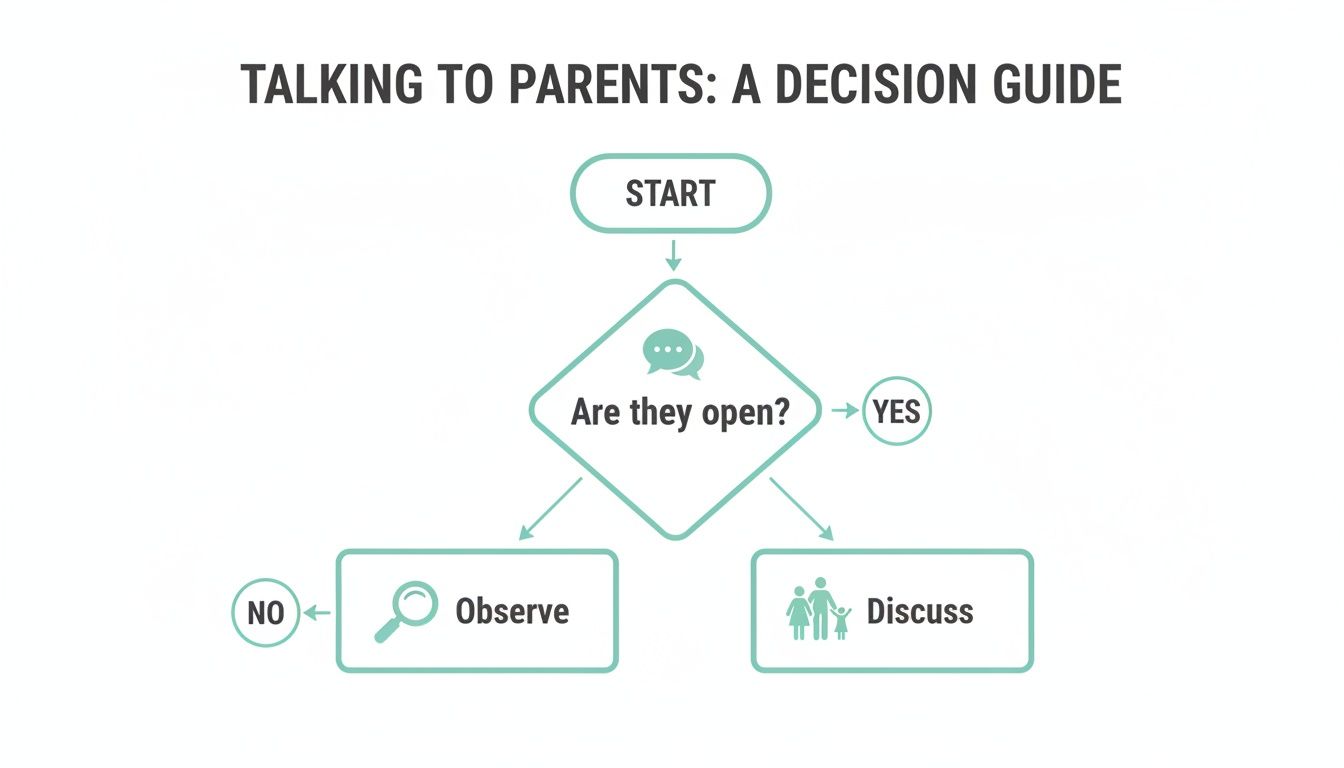
As you can see, if your parents aren't immediately open to talking, the best next step is to simply gather more specific observations. This strengthens your case for when you bring up the topic again.
From Observation to Action
Jotting down these observations over a few weeks helps create a much clearer picture. It moves the issue from a vague, nagging worry to a fact-based assessment of their needs. You might still be unsure if what you're seeing is serious enough to warrant a major change. Our guide on when it is time for assisted living can give you some extra clarity and confidence.
When you can say, "Mom, I noticed you've fallen twice this month, and I'm worried about you being alone," it carries so much more weight than just saying, "I think you need more help."
This evidence-based approach feels less like a judgment and more like a partnership. You aren't just pointing out problems; you are identifying challenges that communities like Forest Cottage Senior Care are specifically designed to solve. When you have these examples ready, you are far better prepared to have a productive, loving, and effective conversation. This prep work is the true foundation for a successful talk.
How to Plan Your Conversational Approach
A good, productive conversation about assisted living doesn't just happen on its own. It’s almost never a spontaneous breakthrough. Success comes from laying the groundwork with care and empathy, not from trying to wing it in a moment of crisis.
Planning your approach allows you to guide the chat with purpose, making sure your parents feel heard and supported, not cornered or ambushed. This is less about having a perfect script and more about creating the right environment for a real dialogue to unfold.
Unify the Family Front
If you have siblings, your very first step—before you even think about talking to your parents—is to get on the same page. A united front is a supportive one. Nothing will shut down the conversation faster than siblings disagreeing or, even worse, arguing in front of your parents. That just creates confusion and immediately puts them on the defensive.
Set up a call or a quick meeting with your siblings beforehand. Talk through what you’ve each observed, agree on the ultimate goal, and decide who might be best to lead the conversation. This ensures you’re all sending the same message: we love you, we're concerned, and we're in this together.
A unified message from all their children shows your parents this isn't just one person's agenda. It's the entire family coming together out of a shared sense of love and responsibility for their well-being.
Choose the Right Time and Place
Timing is everything. Absolutely do not bring this up during a chaotic holiday dinner, a stressful family event, or right after they’ve come home from a difficult doctor's appointment. Dropping this topic into a high-pressure moment is a recipe for resistance.
Instead, look for a low-key window of time when everyone is calm, rested, and not rushing off to the next thing. Choose a comfortable, neutral spot—like their living room on a quiet afternoon—where they feel relaxed and in control, not trapped.
Consider a Professional Opinion
Sometimes, the message lands differently when it comes from a trusted, objective expert. Bringing in a professional can lend weight to your concerns and take some of the emotional heat out of the conversation.
You could involve:
- Their Primary Doctor: A physician can frame the need for more support in clear medical terms, focusing on safety, health, and preventive care.
- A Geriatric Care Manager: These pros are experts at assessing a senior’s needs and are skilled at mediating these exact types of family discussions.
- A Trusted Clergy Member or Family Friend: Sometimes a respected figure in their life can help them see the idea from a new, less threatening perspective.
When a professional weighs in, it’s no longer just their kids suggesting a huge life change; it’s a respected authority offering sound advice.
It's also helpful to know that the senior living landscape is growing to meet demand. The U.S. sector is projected to expand by USD 130.9 billion between 2025 and 2029. This means there are more high-quality, specialized options than ever before. But waiting too long can have real financial implications, especially since Medicaid covered 52% of long-term care costs in 2020. You can explore additional senior living market insights on fortunebusinessinsights.com to get a better sense of the industry.
Tailor Your Conversational Style
Finally, think about who your parents are. How do they handle big news? Are they practical? Independent? Wary of change? Customizing your approach to their personality will make them far more open to listening. Having a few talking points ready can also help. To get started, you may find it useful to check out our guide on key questions to ask assisted living facilities, which can help you frame the conversation.
It's not one-size-fits-all. You have to match your approach to your parent. Here's a table to help you think through what might work best.
Choosing Your Conversation Style
| Approach Style | Best For Parents Who Are… | Key Talking Point |
|---|---|---|
| The Direct Approach | Practical, logical, and no-nonsense thinkers. They appreciate straightforward facts and clear solutions. | "Dad, I've noticed a few things that are making me concerned about your safety. Can we look at some options together?" |
| The Exploratory Approach | Inquisitive, independent, and like to be in control of their own research and decisions. | "Mom, I was reading about some new senior communities nearby. Would you be open to just visiting one with me? No pressure." |
| The Gradual Approach | Resistant to change, anxious, or easily overwhelmed. They need time to warm up to new ideas. | "I know a friend whose mom moved into Forest Cottage, and she loves it. She said the food is wonderful." (Planting a seed) |
Thinking through these styles can help you find a starting point that feels natural for you and, more importantly, respectful of them. The goal is to open a door, not force a decision.
Navigating the Talk with Practical Scripts and Strategies
Once you’ve done your prep work, it’s time to actually sit down and have the conversation. This is where a few simple communication strategies can make all the difference. Your goal is to come from a place of love and support, not to sound like you're making accusations or demands.

The single most powerful tool in your toolbox is using "I" statements instead of "you" statements. It’s a subtle shift, but it changes everything. When we hear "you," it can feel like a judgment, instantly putting us on the defensive. But an "I" statement is just you sharing your own feelings and observations—and that's much harder to argue with.
- Instead of saying: "You’re not safe living alone anymore."
- Try something like: "I’ve been so worried since your fall last week, and it makes me anxious thinking about you being here by yourself at night."
See the difference? It transforms the conversation from a confrontation into a collaboration. It opens the door for them to understand your perspective without feeling attacked.
Handling Common Objections with Empathy
Be prepared for objections. It’s a completely natural reaction to a massive life change, so don't be discouraged. Your job isn't to "win" the argument but to listen, validate their feelings, and then gently reframe the situation. Listen for the fear behind their words.
Here are a few common pushbacks I’ve heard over the years and how you might respond:
Objection: "I'm perfectly fine on my own. I don't need any help."
- Empathetic Response: "I know how important your independence is, and you've always handled everything so well. My concern isn’t that you can't manage, but that you have to manage so much. I was just thinking about how much easier life could be without the stress of house repairs or cooking every single meal."
Objection: "I can't afford that. It's way too expensive."
- Empathetic Response: "That's a completely valid concern, and we absolutely need to look at the numbers together. But I wonder, when we add up the mortgage, utilities, groceries, and home maintenance, how the costs really compare. We might be surprised. Plus, many places have programs to help, especially for veterans."
Objection: "I don't want to leave my home and all my memories."
- Empathetic Response: "This house holds so much of our family's history, and I know the thought of leaving it is incredibly hard. I get that. The idea isn't to replace those memories, but to find a new home where you can be safe and happy, and we can start making new memories together."
Active listening is your superpower here. Acknowledge their fears out loud by saying things like, "It sounds like you're worried about…" or "I'm hearing that you feel…" This shows you respect their viewpoint, even if you see things differently.
Painting a Positive and Realistic Picture
For many seniors, the term "assisted living" conjures up an outdated, grim image. Part of your role is to help them see what modern communities are actually like. Don’t just talk in generalities; use specific, appealing examples that resonate with them.
Focus on what they will gain, not what they might lose.
You can paint a much more vivid picture by highlighting amenities that align with their personal interests. For example, at a community like Forest Cottage Senior Care, you could mention:
- Enjoying chef-prepared meals three times a day, which means no more stress about grocery shopping and cooking.
- Having access to on-site beautician services, making it easy to always look and feel their best.
- The comfort of unique programs like Goldendoodle pet therapy sessions that bring so much joy and reduce stress.
By focusing on these tangible benefits, you help shift their perception from one of loss to one of opportunity. Research actually shows that assisted living residents enjoy 40% more social engagement, which can dramatically reduce loneliness and isolation. And with the global senior care market expected to hit USD 98.19 billion by 2032, you can bet that communities are investing heavily in these kinds of life-enriching amenities. You can explore more insightful senior living statistics on Caring.com.
For some parents, especially those with cognitive decline, the idea of a full move is just too overwhelming. In that case, a gentle introduction through a trial stay might be a much better approach. You could explore the benefits of respite care for dementia patients, which offers a low-pressure way for them to experience the community firsthand before making any big decisions.
Taking the Next Steps Together as a Family

That first conversation is a huge milestone, but it’s just the start of the journey, not the finish line. Keeping that positive momentum going is everything. The key is to shift into gentle, low-pressure actions that keep your parents firmly in the driver’s seat.
Instead of pushing for a big decision, frame the next moves as simple exploration. Suggesting a tour of a local community isn't about signing papers; it's just a fact-finding mission.
You could try something like, "I heard Forest Cottage has lovely grounds and they serve lunch to visitors. Why don't we go have a look next week, just to see what these places are actually like? No strings attached."
This approach dials back the pressure and transforms a scary task into a casual, shared experience. It gives them the space to absorb the environment at their own pace.
Exploring Options Without Commitment
Another really effective strategy is to float the idea of a "trial run." This can make the whole concept of assisted living feel a lot less permanent and intimidating. A short-term respite stay or even just participating in a senior day care program can be a fantastic way for your parent to experience the benefits firsthand.
Think about these low-commitment pathways:
- Respite Stays: A weekend or a week-long stay gives them a real taste of the community’s vibe, the meals, and the social life.
- Senior Day Programs: Just joining in on activities for a day provides social connection and a peek into the daily rhythm.
- Community Events: Many places host events open to the public, offering another casual way to pop in and see what's happening.
Gathering Objective Information
To further empower your parents and ground the decision in facts, think about scheduling a professional care assessment. Getting an objective, expert opinion from a geriatric care manager can validate your concerns and provide clarity on the exact level of support they might need.
This is also the perfect time to explore the financial side of things together. Researching options like VA Aid and Attendance benefits for veterans or figuring out the best way to manage assets becomes a practical, collaborative project. You can also tackle the logistics of a potential move as a team; for instance, you can learn more about downsizing help for seniors to make that process feel more manageable.
Every step you take from here should reinforce one message: this is their decision, their future, and their choice. By acting as their research partner and supportive guide, you help them feel respected and in control as they navigate this next chapter.
Handling the Tough Questions About Assisted Living
Even with the best intentions and a lot of planning, you're going to run into some tough questions and big emotions. That's completely normal. Knowing how to handle the most common objections can keep the conversation moving forward and focused on finding a good solution for everyone.
What If My Parents Flat-Out Refuse to Discuss It?
This is a big one. If you hit a brick wall and they just refuse, the worst thing you can do is push. Don't force it.
Acknowledge their feelings, tell them you hear them, and suggest picking it up again in a week or so. In the meantime, you can plant a few gentle seeds. Maybe leave a brochure for a place like Forest Cottage on the coffee table or mention how a friend's parent is thriving after making a similar move.
Sometimes, the messenger is the problem. Bringing in a trusted outsider—their doctor, a pastor, or a respected family friend—can help. They can often mediate the discussion from a more neutral, objective place.
How Can We Afford Assisted Living in Willis, Texas?
Money is almost always a top concern, but there are usually more options than families realize. The first step is to get a clear picture of all their financial resources. This includes things like long-term care insurance policies, pensions, Social Security benefits, and the equity in their home.
It's also really important to look into programs they might qualify for, like the VA Aid and Attendance benefit for veterans. This can be a huge help. Communities like Forest Cottage Senior Care can be a great resource for navigating these financial questions and might even help with the costs associated with applying for veterans' benefits.
My Parent Is Worried About Losing Their Independence
This might be the single most common fear we hear from families. The key here is to completely reframe what "assisted living" means.
It’s not about taking independence away; it’s about enhancing it. You have to emphasize what they will gain.
By getting support with the daily burdens—cooking every meal, scrubbing floors, keeping up with home maintenance—they free up their time and energy for things they actually want to do. Think hobbies, visiting with friends, and joining community activities.
Point out specific things that actually give them more freedom, like scheduled transportation for errands and doctor's appointments. Frame the move as a way to get the support they need to live a more active, engaged, and truly independent life.
Talking through these issues is the first, most important step toward making sure your parent is safe and happy in the years to come. The team at Forest Cottage Senior Care is here to help your family explore every option with compassion and real-world experience.
You can schedule a personal tour and see for yourself what modern senior living is all about.