

When you're looking for a short-term break from caregiving, the first question that pops into your head is usually about the bottom line. The respite care cost per day can land anywhere from about $100 to over $350. The final price really hinges on the type of care, the level of support needed, and of course, where you live.
It helps to think of it like booking a hotel—the final bill depends on whether you just need a basic room or a full-service suite with all the bells and whistles.
Answering Your Respite Care Cost Questions
Getting a handle on the cost of respite care is the first real step toward finding the support both you and your loved one need. It’s not one single number but a whole spectrum of options designed to fit different situations and budgets. The key is understanding what you're paying for and which setting gives you the best value for your money.

To really get the full picture, you can dig deeper into our guide on what respite care is and everything it includes.
The price tag is directly tied to the environment and how intensive the care is. For instance, an adult day center is often a more affordable choice for seniors who just need social engagement and supervision during the day. On the other hand, an overnight stay in an assisted living facility provides 24/7 support, which naturally comes with a higher daily rate.
Comparing Common Respite Care Settings
To give you a clearer picture, let's break down the typical costs you might see. National data shows that the median daily cost for adult day respite care hovers around $103 per day. In-home care from a home health aide averages about $35 per hour, which can add up to roughly $280 for an 8-hour day.
Meanwhile, a short-term stay in an assisted living community comes in with a median daily rate near $200. These figures show just how much variation you can expect depending on the path you choose.
A Snapshot of Average Respite Care Costs Per Day
This table compares the median daily costs for common types of respite care, helping you understand the financial landscape at a glance.
| Type of Respite Care | Typical Daily Cost Range | Best For |
|---|---|---|
| Adult Day Center | $75 – $150 | Social seniors who need daytime supervision and activities. |
| In-Home Care Aide | $240 – $360 (for an 8-hour day) | Seniors who prefer to stay in their own home and need one-on-one assistance. |
| Assisted Living Facility | $150 – $350+ | Seniors needing 24/7 supervision, medication management, and a structured environment. |
Seeing the numbers side-by-side like this makes it easier to weigh the pros and cons of each option against your family's specific needs and budget.
What Determines Your Daily Respite Care Rate
The cost of respite care isn't a simple, flat fee, and for good reason—the service is incredibly personal. Think of it like booking a vacation; the final price tag depends on where you stay, what you do, and how much support you need along the way. Getting a handle on these moving parts is the first step to figuring out your potential respite care cost per day.
A few core factors really shape the final daily rate, from the intensity of support needed to the type of room your loved one will stay in. Let's break them down so you can see exactly where your money is going and make a more informed choice.

Level of Care Required
The single biggest driver of cost is the level of care your family member needs. It makes sense, right? A senior who is mostly independent and just needs some companionship and meals prepared will have a much lower daily rate than someone who needs hands-on help with daily activities like bathing, dressing, and getting around.
The price will also adjust for more specialized care needs. For instance:
- Memory Care: Seniors with Alzheimer's or dementia often need a secure environment and staff specially trained in handling challenging behaviors, which naturally increases the cost.
- Medical Needs: If care involves things like medication administration, wound care, or mobility support from a skilled professional, that requires a higher level of expertise and is priced accordingly.
The more intensive the support, the higher the daily rate. This covers the cost of qualified staff and any special resources needed. You can learn more about different support structures in our guide to assisted living services.
Facility and Accommodation Type
Just like booking a hotel, the room and the community's amenities play a huge part in the price. A private suite will always cost more than a semi-private or shared room. The overall vibe and features of the community contribute, too.
A community with beautiful grounds, chef-prepared meals, and a full calendar of social events will have a different price structure than a more basic facility. These perks add a lot of value to the stay, but they're also reflected in the daily rate.
Length and Frequency of Stay
How long your loved one stays can also influence the daily cost. While some communities have a set daily rate no matter what, others might offer a slightly lower rate for longer stays—say, a full week or a month versus just a day or two. If you plan on frequent, regular stays, you might even find opportunities for loyalty pricing or package deals.
Geographic Location and Market Demand
Finally, where you live matters. The cost of living is higher in major cities, and that trickles down to senior care. A respite stay in a bustling urban area will almost always be more expensive than one in a quieter suburban or rural community, thanks to higher real estate costs, staff wages, and general operating expenses.
Demand is also pushing prices up. Market reports show consistent growth in the senior care industry, with the respite care segment alone projected to grow by 5.48% in just one year. That signals that costs are likely to keep climbing. You can read the full research on global market trends in respite care to see the data for yourself.
How to Budget for Your Respite Care Needs
Knowing the daily rate is a great start, but the real key to confident planning is figuring out what that number means for your wallet. Let's move past the abstract figures and look at how the respite care cost per day actually adds up over a typical stay. Thinking through it this way helps avoid surprises and gives you a much clearer financial picture.
Imagine you just need a short break to recharge. By doing the math for a few different situations, you can get a solid idea of the total cost and plan for it.
Real-World Budgeting Scenarios
Let's walk through two common examples. It’s a great way to see how quickly the final bill can change based on the level of care someone needs.
Scenario 1: The Weekend Getaway. A family needs a break while their loved one, who is mostly independent, gets some light support. They just need medication reminders and meals prepared. They book a three-day stay at a community charging $225 per day.
- Calculation: 3 days x $225/day = $675 total cost
Scenario 2: The Week-Long Vacation. Another family is planning a full week away. Their parent has moderate dementia and needs specialized memory care in a secure environment. This higher level of care brings the daily rate to $320.
- Calculation: 7 days x $320/day = $2,240 total cost
As you can see, the total cost shifts dramatically depending on how long the stay is and how much hands-on support is required.
Projecting Your Total Costs
To make budgeting even simpler, it helps to see how the costs build up over different lengths of time. The table below is a quick-and-dirty reference guide for estimating your total expense using a few sample daily rates. It's a handy tool for getting a ballpark figure for both short and longer breaks.
Sample Respite Care Cost Projections
See how total costs accumulate based on the daily rate, length of stay, and different care scenarios.
| Care Scenario | Daily Rate | Length of Stay | Estimated Total Cost |
|---|---|---|---|
| Basic Assistance | $225 | 3-Day Stay | $675 |
| 7-Day Stay (1 Week) | $1,575 | ||
| 14-Day Stay (2 Weeks) | $3,150 | ||
| Moderate Support | $275 | 3-Day Stay | $825 |
| 7-Day Stay (1 Week) | $1,925 | ||
| 14-Day Stay (2 Weeks) | $3,850 | ||
| Specialized Memory Care | $320 | 3-Day Stay | $960 |
| 7-Day Stay (1 Week) | $2,240 | ||
| 14-Day Stay (2 Weeks) | $4,480 |
This table shows just how important it is to consider all the factors when you're estimating the cost of a respite stay.
Key Takeaway: Budgeting for respite care isn't just about the daily rate. The total cost is a combination of that daily price, how long the stay is, and the specific level of care your loved one needs.
By mapping out these projections, you can plan much more effectively. For families exploring their options, understanding the different types of temporary senior care available is a great next step. This kind of proactive approach makes sure you can get the support you need without adding financial stress.
Exploring Ways to Pay for Respite Care
Seeing the respite care cost per day can be a little jarring at first, but you have more options than just paying out-of-pocket. There are several financial paths that can make this essential support much more affordable. Families can move beyond private savings and tap into insurance plans, government benefits, and other programs designed to ease the financial load.
Taking the time to understand these avenues is so important. Without support, the costs can quickly become a major hurdle. Policy analyses from KFF show that median monthly costs for this type of care can run anywhere from $4,957 to $5,148, a figure that really drives home the need for financial planning and assistance.
Long-Term Care Insurance
One of the best tools for managing senior care costs is Long-Term Care (LTC) insurance. These policies are specifically built to cover services like assisted living and respite stays, but as with any insurance, the devil is in the details.
You'll want to look at your policy's "elimination period"—that's the waiting period before benefits kick in—and its daily benefit amount to see what it will cover. It's vital to review your plan to confirm if respite care is an explicitly covered service. We offer more guidance on understanding long-term care insurance coverage for assisted living that can help you make sense of your policy's terms.
VA Benefits for Veterans
For those who have served our country, the Department of Veterans Affairs (VA) offers significant support. Veterans and their surviving spouses may be eligible for benefits that can be put toward the cost of respite care.
Two key programs to look into are:
- Aid and Attendance: This pension benefit gives monthly payments to eligible veterans who need a hand with daily activities, like bathing or dressing.
- Housebound Benefits: This is for veterans who are mostly confined to their homes because of a permanent disability.
These funds are flexible and can be applied directly to respite care expenses, offering a critical financial lifeline for many military families.
Medicaid and State Waivers
Medicaid can be another valuable resource, but its coverage for respite care really depends on the state you live in. While standard Medicaid might not always list respite as a core benefit, many states offer what are called Home and Community-Based Services (HCBS) waivers.
These waivers are designed to help seniors get the care they need in their community instead of a nursing home. Respite care is often a covered service under these programs, giving family caregivers that much-needed break.
Eligibility for Medicaid and these waivers is based on pretty strict income and asset limits, so you'll need to check your state's specific requirements.
This flowchart breaks down the simple steps for creating a budget, from figuring out the daily rate to calculating your total expense.
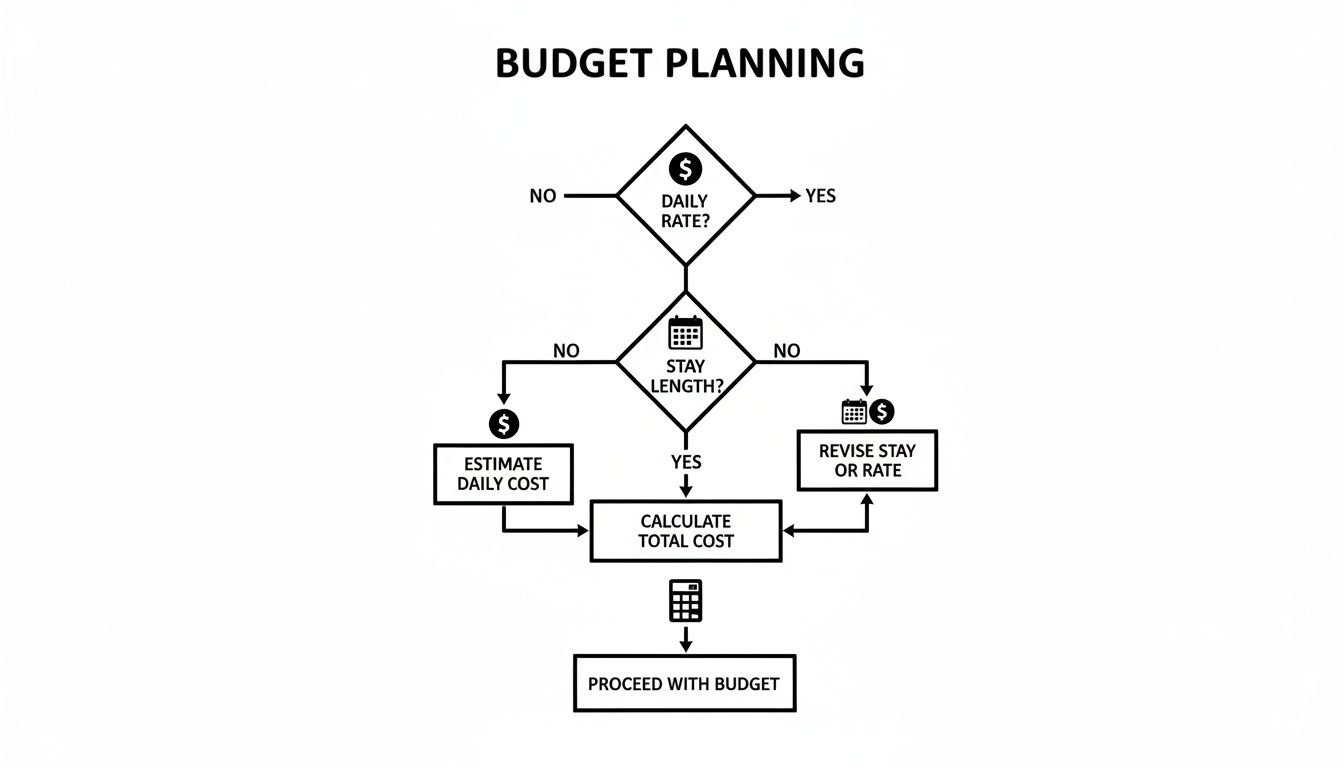
As the visual shows, good financial planning starts with breaking the cost down into smaller, more manageable pieces. By clarifying the daily rate and the length of the stay first, you can get a realistic projection of the total cost and match it up with the payment options available to you. That way, there are no surprises down the road.
Finding Value at Forest Cottage Senior Care in Texas
Knowing the numbers behind the respite care cost per day is one thing, but seeing how it all comes together in a real community is what truly matters. Here at Forest Cottage Senior Care in Willis, Texas, we know that real value isn’t just about the daily rate. It's about the complete, compassionate experience we create for every single person who stays with us, even for a short time.
Our mission is to give you peace of mind by offering a genuine home-away-from-home where your loved one feels safe, happy, and truly looked after.
When a senior joins us for respite care, they're not just a temporary resident; they're family. The experience we provide goes so much deeper than simple supervision. The daily rate at Forest Cottage is packed with benefits designed to support comfort and well-being from the moment they arrive.

A Supportive and All-Inclusive Environment
What really makes Forest Cottage stand out is our commitment to a simple, all-inclusive approach. We bundle all the essential services into our respite program, which means you won't have to worry about hidden fees or surprise charges. It makes budgeting so much easier for families.
Our respite stays include:
- Delicious, Home-Cooked Meals: We serve three wholesome and tasty meals every day, plus snacks, all prepared with care right in our own kitchen.
- Personalized Daily Activities: We keep life interesting and fun with everything from gentle exercise and social events to pet therapy with our lovable Goldendoodles.
- 24/7 Professional Oversight: Our dedicated team is always on-site, ready to help with medication reminders, offer assistance, and ensure everyone is safe around the clock.
This structure means families in the greater Houston area get incredible value. You can rest easy knowing your loved one is receiving holistic care that nurtures their physical, social, and emotional health.
Expert Guidance on VA Benefits
Figuring out how to pay for care can be one of the most stressful parts of this journey. For military families, we offer a truly unique service. We have direct, hands-on experience helping veterans and their spouses apply for and use their VA benefits, like Aid and Attendance, to help cover the costs.
We are so passionate about supporting our veterans that we even cover the legal fees associated with the VA application process. It’s our way of giving back and removing a huge financial hurdle for those who have served our country.
By tying our care services directly to the payment solutions you have available, we become your partner in making top-quality care accessible. We invite you to learn more about our specific respite care offerings and discover how we deliver a caring, supportive, and cost-effective solution for your family.
Planning Ahead for Peace of Mind
Getting a handle on the respite care cost per day is your first real step toward making caregiving a marathon, not a sprint. This guide has laid out the factors that move the needle on price, shown you how to put together a budget that makes sense, and pointed you toward financial help that's out there. But let's be honest, proactive planning is about so much more than just the numbers—it’s about protecting yourself.
Taking a break isn't a luxury—it's a critical component of effective caregiving. Preventing burnout ensures you can continue providing the best support for your loved one long-term.
When you think ahead, you avoid making panicked decisions in the middle of a crisis. That forethought means your family member gets the thoughtful, compassionate care they deserve whenever you need to step back for a bit. Don't wait until you're running on fumes to start looking at your options.
Take control of the situation by reaching out to a trusted place like Forest Cottage Senior Care. A simple chat today about your family's unique needs can give you the support and peace of mind you'll need for tomorrow. It’s about securing a healthy future for both of you, and our team is here to help you walk through it with clarity and confidence.
Frequently Asked Questions About Respite Care Costs
When you're trying to budget for the respite care cost per day, a lot of questions can pop up. Getting straight answers helps you plan with confidence and sidesteps any surprises later on.
Does Medicare Cover Respite Care Costs?
This is a big one for many families. The short answer is that, in most situations, Original Medicare does not cover general respite care.
There is one major exception: hospice care. Under Medicare Part A, a patient receiving hospice may be covered for a respite stay of up to five consecutive days in a certified facility. This is specifically designed to give the primary caregiver a much-needed break. Outside of hospice, though, you'll likely need to plan for other ways to pay.
Is Respite Care More Expensive for Dementia?
Yes, it's pretty standard for respite care to have a higher daily rate when it's for someone living with dementia or Alzheimer's. That extra cost isn't arbitrary; it covers the specialized support that memory care requires.
You're typically paying for things like:
- Higher Staff-to-Resident Ratios: It simply takes more trained hands on deck to provide safe, attentive supervision.
- Secure, Safe Environments: These communities have enhanced safety features to prevent wandering and keep residents safe and comfortable.
- Specialized Activities: The programming is thoughtfully designed to engage residents with cognitive decline in a meaningful way.
How Far in Advance Should I Book?
My best advice? Plan ahead. It’s always a good idea to book respite care at least a few weeks in advance. If you're looking at a popular time, like a major holiday, you'll want to book even earlier.
Booking early doesn't just guarantee you'll get a spot—it can also help you lock in a better rate before seasonal demand drives prices up.
Can I Use an FSA or HSA for Respite Care?
You might be able to. Funds from a Flexible Spending Account (FSA) or Health Savings Account (HSA) can often be used for qualified medical expenses, and the medical services portion of a respite stay can fall into that category.
The key is to check with your specific plan administrator. They can confirm if it's an eligible expense and tell you exactly what kind of documentation you'll need to provide.
At Forest Cottage Senior Care, we believe in clear, upfront information to help you make the best decision for your family. Explore our respite care services and find the support your family needs.